
Advertisement
Macroscope
Opinion
Nicholas Spiro

Macroscope | Slowdowns in advanced economies have pushed investors to put money back into emerging markets – and ignore warnings

  • The hunt for high returns amid sluggish results for advanced economies has seen investors move back into emerging markets, including exceedingly risky ones

Reading Time:3 minutes
Why you can trust SCMP
Bernward Reif, CEO of Otto Junker, looks over the factory floor at the company's metals plant in Simmerath, Germany, on February 19. The slowdown in Chinese growth has hit manufacturing hard in Europe’s biggest economy, with orders and output sharply contracting in January. Photo: Bloomberg
On Monday, Germany’s statistics bureau announced that industrial output in Europe’s largest economy contracted in January by 3.3 per cent year on year. The data came on the heels of a separate report last week revealing that factory orders also shrank in January, providing further evidence that Germany’s export-driven economy – which narrowly avoided a recession at the end of last year – is bearing the brunt of the slowdown in China. 
The deceleration in Germany contributed to last week’s decision by the European Central Bank to join the US Federal Reserve in performing a dovish U-turn in monetary policy in response to mounting headwinds to growth. Having terminated its quantitative easing programme last December, the ECB reversed course, announcing that it will provide another round of cheap loans to euro-zone banks and will keep interest rates at historic lows until next year.
The dramatic policy reversals on the part of both the ECB and the Fed, which only several months ago were at different stages in the process of withdrawing stimulus, stem partly from the persistence of muted inflationary pressures. In the euro zone, headline inflation has slipped back to 1.5 per cent – down from 2.3 per cent last October – while the core, or underlying, rate has been stuck at close to 1 per cent for the past three years, half the ECB’s target. Even in America, which is close to full employment and whose economy is more buoyant, headline inflation stood at 1.5 per cent in January, the smallest increase since September 2016.
Advertisement

While both central banks are hoping that the recent downshift in growth – which stems in part from the fallout from the trade war – will prove temporary, the dovish policy shifts in Europe and America prolong the “lower for longer” interest rate regime that appeared to be coming to an end as the pace of US monetary tightening quickened in 2017 and 2018. Some investors, notably Pimco, an asset manager, fear the euro zone faces the same low-growth, low-inflation environment Japan has endured following the bursting of its asset price bubble in the early 1990s.

While there are stark differences between the Japanese and European economies, there are also worrying parallels in government bond markets. The benchmark 10-year yield in Germany has plunged 50 basis points since early October to a mere 0.07 per cent as the euro-zone economy has faltered. This is just 11 basis points above its Japanese equivalent, which has been kept at close to zero per cent by the Bank of Japan since 2016 and is once again back in negative territory.
Advertisement
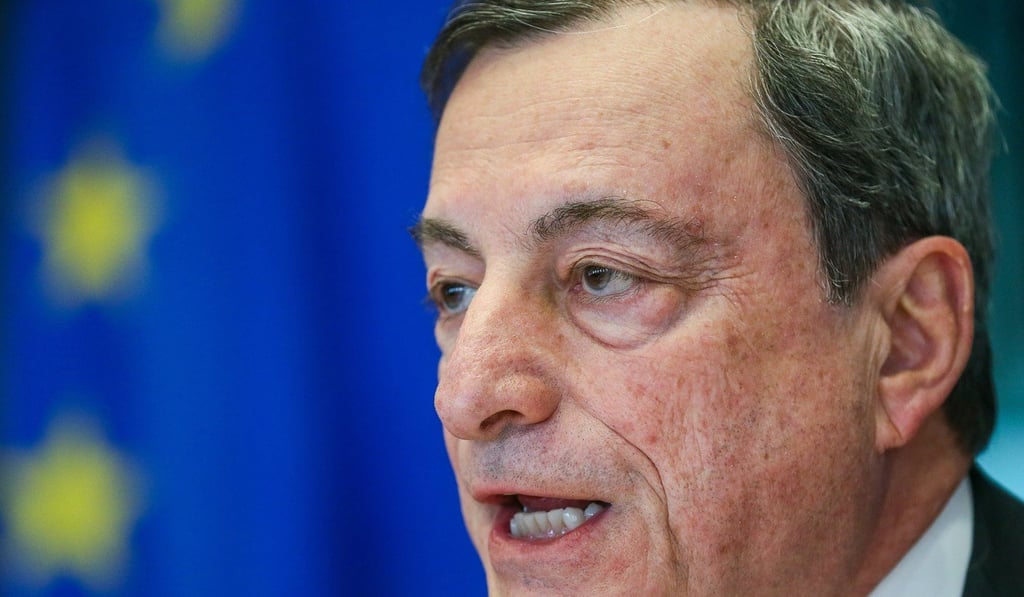
European Central Bank President Mario Draghi said on March 7 that growth across the euro zone would be just 1.1 per cent in 2019, and announced a package of stimulus measures. Photo: EPA-EFE

Indeed, according to data from Bloomberg, the global stock of negative-yielding debt – practically all of it owed by governments and companies in Europe and Japan – has surged since last October to almost US$9 trillion, on a par with its level in 2017.

Advertisement
Select Voice
Choose your listening speed
Get through articles 2x faster
1.25x
250 WPM
Slow
Average
Fast
1.25x