John Tsang should know that easy money doesn’t last, and Hong Kong must urgently adapt to new realities
Regina Ip says a long-term economic strategy to reorient the city’s tourism, trade, transport and logistics industries is of great importance, but you won’t find anything of the sort in the financial secretary’s budget

In 2011, Financial Secretary John Tsang Chun-wah sparked a storm of protest by proposing in his budget to inject HK$6,000 into the Mandatory Provident Fund account of every employee. His proposal met such withering attacks that he had to replace it with a cash injection of HK$6,000 into the bank account of every Hong Kong permanent resident.
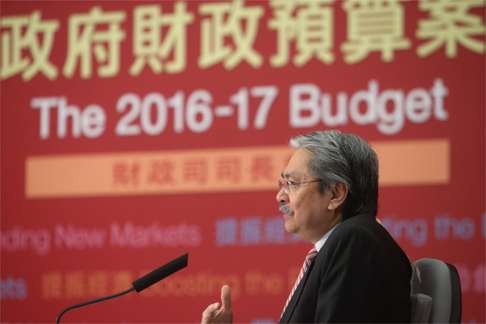
Now, in his ninth year as financial secretary, Tsang has become an old hand at this game. In presenting this year’s budget, he sprinkled his narrative with “nativist” rhetoric that helped win plaudits from harsh critics of the government. Tsang’s efforts to stack up “sandbags” against future financial tsunamis – that is, saving for the future – received much less public recognition, but deserve close scrutiny.
Tsang deserves full credit for stashing away mountains of cash for future use. Hong Kong’s fiscal reserve amounts to a whopping HK$860 billion. A “future fund” of HK$220 billion has been established to provide for the rapid ageing of the population. A further HK$74 billion has been set aside as “housing reserve”, while another HK$200 billion has been put into the kitty to finance a 10-year hospital development plan. Tsang has done his level best in protecting the public coffers from possible unseemly uses.
Big business wins again in John Tsang’s budget for Hong Kong
Tsang’s performance as economic tsar tasked with the responsibility of propelling sustainable economic development, however, is much less impressive. Tsang presided over a recovery fuelled by the economic expansion of China and the arrival of large numbers of mainland Chinese tourists under the “individual visitor scheme”. In 2015, Hong Kong hosted over 59 million visitors, of which 76 per cent came from mainland China. Hong Kong’s economic leaders allowed the city to be swept along in a heady tide of easy money without forewarning the industry of the downsides of over-reliance on mainland tourism.
It came as no surprise that when tourist arrivals crashed in recent months (down 13 per cent in the first two months of this year), the government seemed clueless about the strong measures needed to relaunch Hong Kong. It can do nothing about Hong Kong’s loss of price competitiveness. It has no long-term plan for building new mega-attractions on par with Shanghai’s new Disney theme park or nearby Hengqin’s Ocean Kingdom theme park. It has no visible plan to launch high-profile international promotions to boost Hong Kong’s attractiveness. For a long time, the government and tourism authorities have been silent on the need for the local tourism and related industries to improve.