Advertisement
There’s a deep malaise at the heart of Hong Kong politics
Mike Rowse says it is a sorry testament to the city’s political development that the strongest candidates for chief executive are all forced to blatantly put on an act when meeting powerful rural interests
Reading Time:3 minutes
Why you can trust SCMP

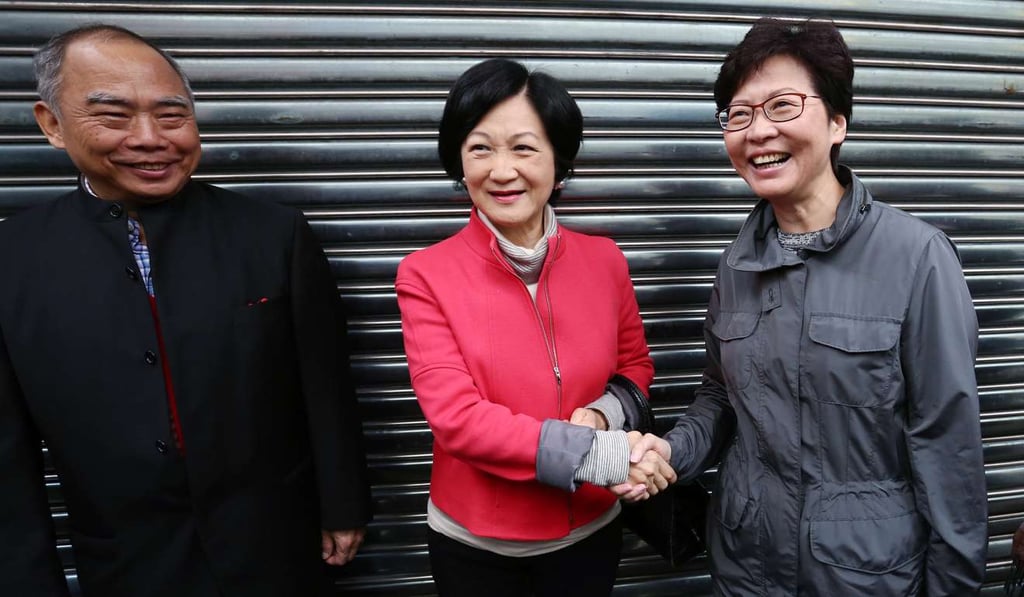
Hong Kong’s three leading candidates for chief executive queued up one by one earlier this month to lobby for support from the Heung Yee Kuk. All three had no alternative but to kowtow to the powerful rural body – at stake were not only the 26 votes in the Election Committee held by the kuk in its own name, but also the 60 votes held by the agriculture and fisheries sector over which the body’s leading lights exercise a fair degree of influence.
You read that correctly: a significant bloc of 86 out of the 1,200 people or so who will decide who holds our highest public office for the next five years. By way of comparison, the financial services sector has 18 votes.
Advertisement
Kuk members basically want two things: the glorious gravy train of the small-house policy to roll forward unchecked; and for a blind eye to continue to be turned to illegal alterations and additions to existing village properties. They were not disappointed.
Everyone in Hong Kong knows that the small-house policy cannot possibly continue
Everyone in Hong Kong – including, one assumes, the three candidates themselves, plus, in their hearts, the members of the kuk – knows that the small-house policy cannot possibly continue. It gobbles up precious land with three-storey luxury villas in low-rise rural settings when there is a shortage of sites for intensive development to accommodate the hundreds of thousands of inadequately housed urban residents. Yet, on the day, all three pretended not to know. A fourth candidate, retired judge Woo Kwok-hing, had sailed a similar course on an earlier occasion.
Advertisement
Former chief secretary Carrie Lam Cheng Yuet-ngor ducked the issue by claiming the small-house policy was the subject of legal proceedings. This was a cop-out. One aspect of the way the policy is implemented is under scrutiny by the courts, but the underlying rationale of the overall policy is not. Lam did speak up on the issue of illegal alterations. Some years ago, as development secretary, she promoted a scheme to get villagers to register their changes for “temporary exemption”. Rural leaders vehemently opposed the scheme and publicly urged a boycott, but now pretended that some villagers had “missed their chance”. Lam thought the scheme might be reopened.
Advertisement
Select Voice
Choose your listening speed
Get through articles 2x faster
1.25x
250 WPM
Slow
Average
Fast
1.25x