Beijing now calls the shots in the South China Sea, and the US and Asean must accept this for lasting peace
Mark J. Valencia says China’s perceptual domination of the sea lanes is complete and, military grandstanding aside, the US and others in the region will need to focus on realistic goals, rather than desirable ones
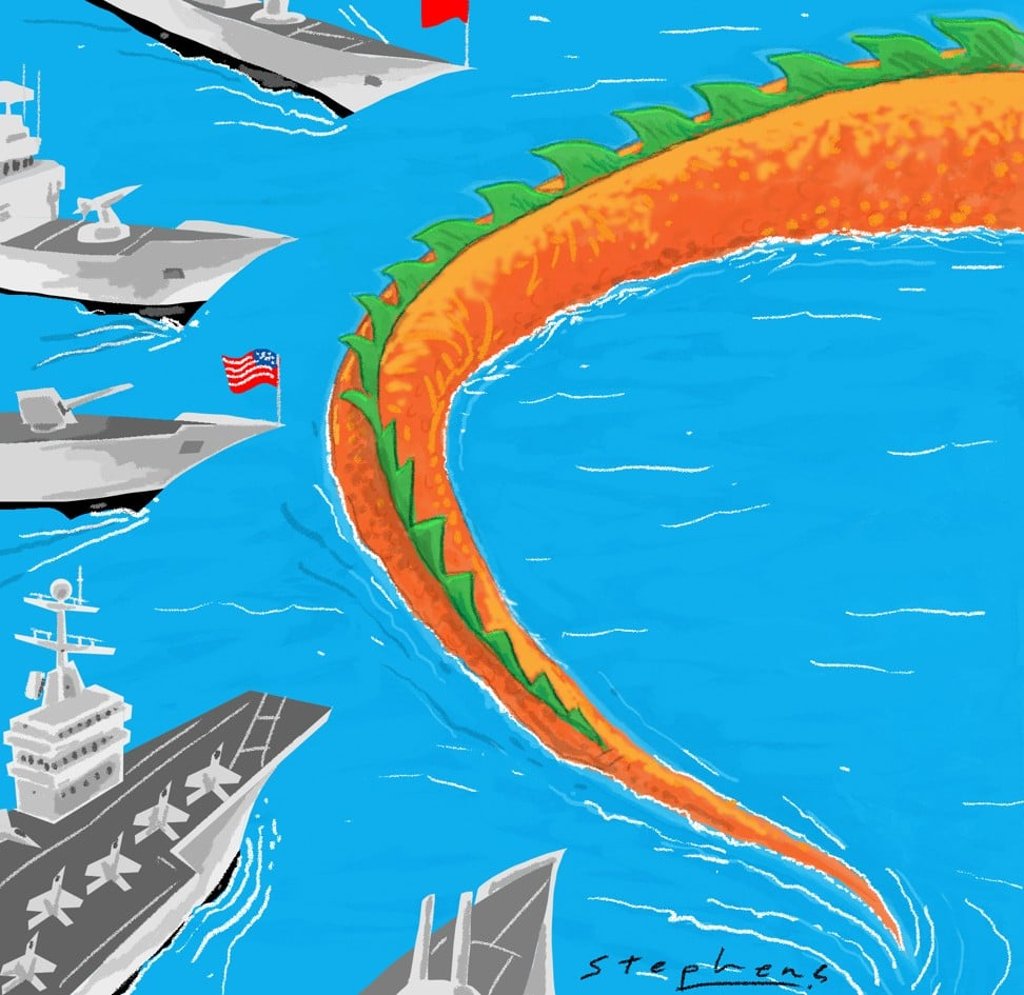
As China rises in power, the Western-built and US-led international order, particularly the UN Convention on the Law of the Sea, continues to haemorrhage, and there is really little Asean or the US can do about it. Illustration: Craig Stephens
The contest for the perceptual domination of the South China Sea, for the Asean claimants and thereby Southeast Asia, is over. China has won. There is little its regional opponents can do now. How did this come about and what are the options for dealing with it?
More significantly, it has done so in the face of US challenges and even shows of force in the form of “freedom of navigation operations” (Fonops), as well as protests from other claimants, like Vietnam and the Philippines. The latter was the first to recognise the futility of opposing China there and the benefits of “working with it”. It is likely that others – like Brunei and Malaysia – will follow suit. Even Vietnam, increasingly the lone and lonely opponent, may be coming round.
Watch: China dismisses South China Sea ruling
The irony is that the contest has been, and still is, primarily perceptual in nature. No commercial shipping has been affected, despite the constant US concern with “freedom of navigation”, nor is it likely to be in peacetime, given China’s heavy dependence on ship-borne trade.
In a real war, China’s military installations would be highly vulnerable to attack and destruction
Indeed, China is just as, or even more, concerned that the US might try to block its shipping traffic in the event of hostilities. Most importantly, a point often lost in the diplomatic hand-wringing is that, in a real shooting war, China’s military installations would be highly vulnerable to attack and destruction; they give China little, if any, strategic advantage in a clash with the US.
Advertisement
The real value for China of its actions and installations is they have shown that the claimants, including US military ally the Philippines, are essentially alone in their contest with China. To be sure, given Philippine President Rodrigo Duterte’s pivot away from the US and President Donald Trump’s inconsistent and confusing policy towards China , the South China Sea and the region have serendipitously enhanced China’s perceptual position. Trump’s abandonment of the US economic initiative with Asia, the Trans-Pacific Partnership, and his “let’s make a deal” approach to foreign policy have left Southeast Asian nations questioning the US will and staying power in the region. The resultant hedging, waffling and even tilting of Southeast Asian countries towards China has only served to illustrate the shallowness and fragility of American security ties in the region.
Watch: Duterte pledges to avoid South China Sea issue in Beijing
So what are the options for the United States in the near term?