US Fed must move faster to raise rates and cut its balance sheet – before another crisis hits
Stephen Roach says with financial markets this frothy, central bankers must aim for a quick reset of crisis-mode policy interventions, and overblown fears of deflation should not hold them back
Three cheers for central banks! That may sound strange coming from someone who has long been critical of the world’s monetary authorities. But I applaud the US Federal Reserve’s long-overdue commitment to the normalisation of its policy rate and balance sheet. I say the same for the Bank of England, and for the European Central Bank’s grudging nod in the same direction. The risk, however, is that these moves may be too little, too late.
Central banks’ unconventional monetary policies – namely, zero interest rates and massive asset purchases – were put in place in the depths of the 2008-2009 financial crisis. It was an emergency operation, to say the least. With their traditional policy tools all but exhausted, the authorities had to be exceptionally creative in confronting the collapse in financial markets and a looming implosion of the real economy. Central banks, it seemed, had no choice but to opt for the massive liquidity injections known as “quantitative easing”.
This strategy did arrest the free fall in markets. But it did little to spur meaningful economic recovery. The G7 economies (the United States, Japan, Canada, Germany, Britain, France and Italy) have collectively grown at an average annual rate of just 1.8 per cent over the 2010-2017 post-crisis period. That is far short of the 3.2 per cent average rebound recorded over comparable eight-year intervals during the two recoveries of the 1980s and the 1990s.
Advertisement
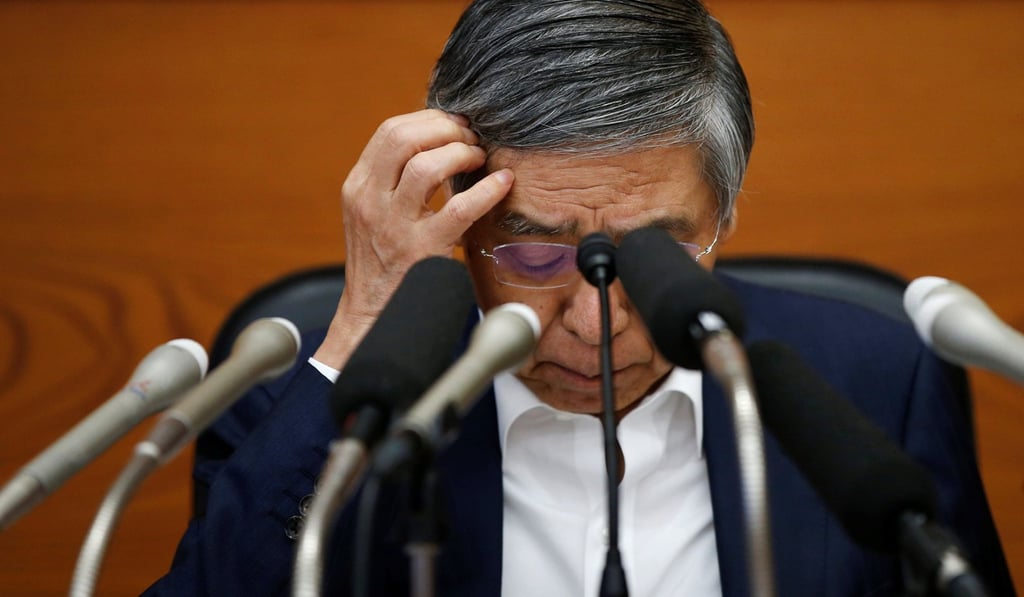
Bank of Japan governor Haruhiko Kuroda attends a news conference at the central bank’s headquarters in Tokyo, on September 21. Central bankers misread the efficacy of their post-2008 policy actions. Photo: Reuters
Unfortunately, central bankers misread the efficacy of their post-2008 policy actions. They acted as if the strategy that helped end the crisis could achieve the same traction in fostering a cyclical rebound in the real economy. In fact, they doubled down on the cocktail of zero policy rates and balance-sheet expansion.
Advertisement
And what a bet it was. According to the Bank for International Settlements, central banks’ combined asset holdings in the major advanced economies (the US, the euro zone and Japan) expanded by US$8.3 trillion over the past nine years, from US$4.6 trillion in 2008 to US$12.9 trillion in early 2017.