Hong Kong’s world won’t stop in 2047, so we’d better start building bridges
Mike Rowse says both sides of the political divide are mistaken in anticipating the end of the Basic Law, and Hong Kong would certainly benefit from more maturity in public discourse
Of my 45 years in Hong Kong, 34 have been spent in the public service and most of the rest with one foot in the media. It follows that I take a close interest in public affairs. All of us who love this city passionately feel let down by the deterioration in the content and style of public discourse in recent years. People on all sides of the political spectrum seem no longer able to have a civilised conversation on issues of the day, tending rather to hurl personal insults at each other and cast doubt on the integrity of opponents at every opportunity.
One area I would like to examine concerns what I consider to be a complete misreading of the significance of 2047. The pan-democrats seem to regard it as the end of the road, so we must cram into our laws and electoral system all the safeguards we can because, after that date, the gloves will be off and we will be at the mercy of the central government.
In the interim, we must oppose pretty much every move the Hong Kong government tries to make. For their part, pro-administration forces seem to see the year as bringing safety at last from the ravages of the barbarians. We just need to hold out another 30 years without meaningful political reform and we’ll be rescued.
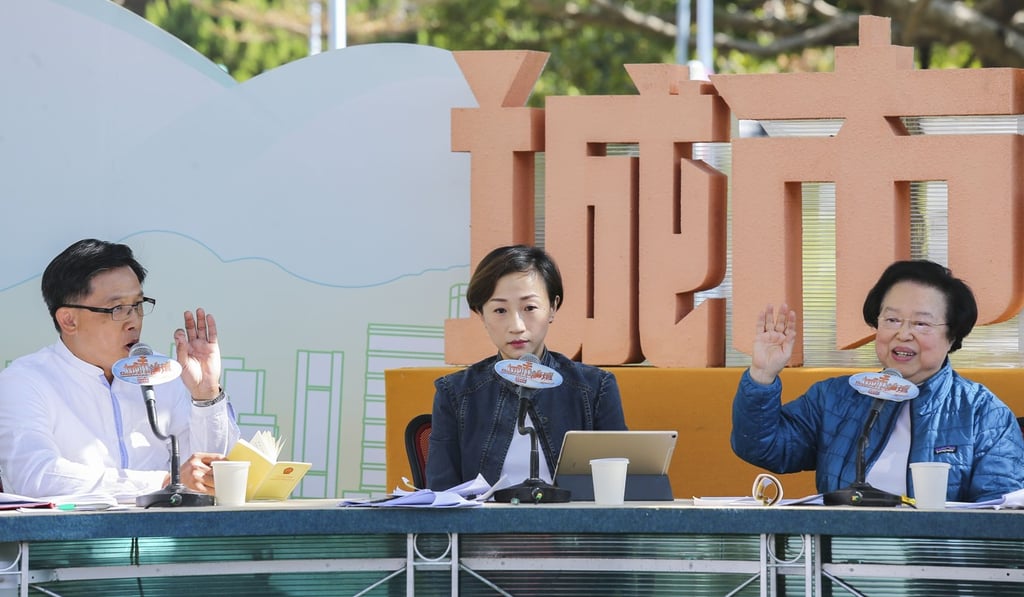
(Left to right) Junius Ho Kwan-yiu, a member of the Coalition of Legal Professionals and Academics Concerning Co-location Arrangement; Tanya Chan Suk-chong, convenor of the Co-location Concern Group; and Maria Tam Wai-Chu, a member of the Basic Law Committee, at a City Forum on the West Kowloon high-speed rail terminus held in December. Photo: Dickson Lee
Both sides are wrong because both have subscribed to the great myth that 2047 is the year the Basic Law expires. I have news for them: it does not. The Basic Law is permanent legislation enacted by the National People’s Congress. It will endure unless and until it is repealed. That does not mean it cannot change either by amendment or interpretation, but there is no sunset clause in the legislation itself.
Advertisement
It is true that one clause – Article 5 – gives a promise that the capitalist system and way of life will remain unchanged for 50 years (from 1997). But it is silent about what will happen after that time. In whose interest is it that there should be an abrupt change? There is more likely to be a series of gentle manageable changes as both Hong Kong and the mainland evolve.
An example of the small adjustments that will arise is the co-location arrangement at the West Kowloon terminus of the high-speed rail. Nobody could foresee at the time the Basic Law was being finalised that such a situation might arise. But when it did, the obvious thing to do was devise a pragmatic solution, which is what the two governments have done.