Why the Catholic Church is right to pursue a deal on bishops with communist China
Tom Plate says the Pope’s willingness to see past the institutional interests of the church should be appreciated, rather than criticised. A more open relationship between Beijing and the Vatican would benefit not only Chinese Catholics, but also the overall development of China

Zen put his opposition thus: “I acknowledge myself as a pessimist ... but my pessimism has a foundation in my long direct experience of the church in China... So, do I think that the Vatican is selling out the Catholic Church in China? Yes, definitely, if they go in the direction which is obvious from all what they are doing ... Am I the major obstacle in the process of reaching a deal...? If that is a bad deal, I would be more than happy to be the obstacle.”
Zen hits back at Vatican rebuke
Zen’s principled views have integrity and, under ordinary circumstances, that should do it. But these are not ordinary times. The world is enmeshed in the consequential process of making room for China. Wisdom requires compromise. Principles on vital questions sometimes have to be “risen above”, as John F. Kennedy memorably put it in noting the functional value of compromise in the US Senate.
In my defence, I offer the similar view of Jorge Mario Bergoglio, the former cardinal of Argentina who is now sovereign of Vatican City, and a priest from the estimable Society of Jesus. If he has not been proving himself the perfect pope for our dangerous times, I cannot imagine who else among the current College of Cardinals could do better. This pope, taking his pontifical title from St Francis of Assisi, offers contemporaneous vision: the ability to see reality from multiple perspectives, not just from the institutional interests of the church.
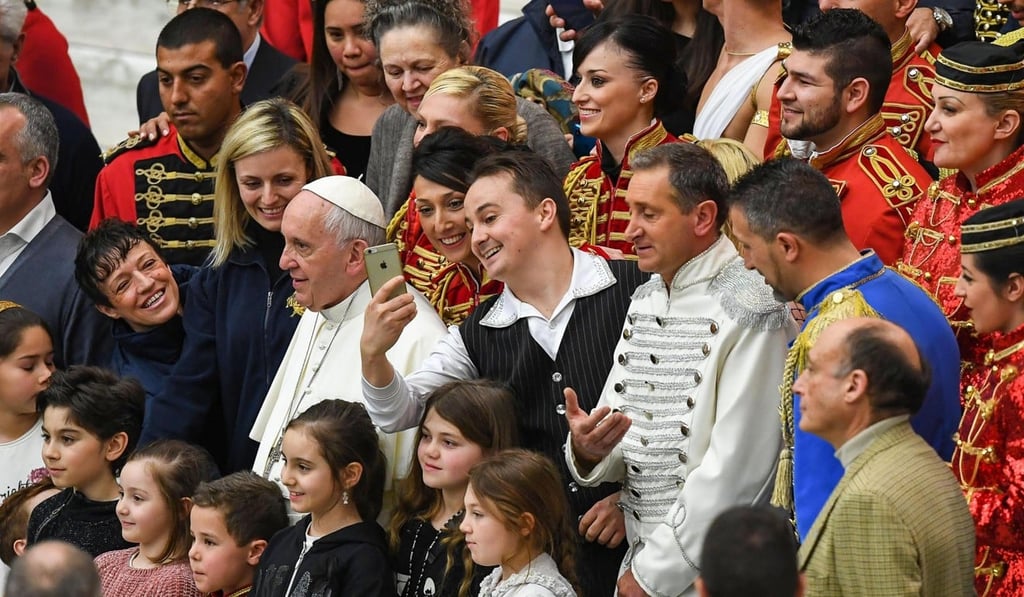
Pope ‘loves China’, Vatican official says on trip to Beijing
Pope Francis knows that communism provides no intellectual warmth for traditional religions such as Islam, Protestantism and Catholicism. He knows that the good communist scoffs at the notion of a heavenly afterlife and so focuses on transforming the material present. And he is well aware of the long Chinese cultural tradition of the emperor as “the son of heaven”. So why worship imagined “holy ghosts” floating around that no one can even see? It’s madness.
Beijing today, while no choirboy, seems more willing to create space for religious belief