Hongkongers see homeownership as an investment. This has to stop
Regina Ip says Hong Kong must address the four factors of supply, demand, liquidity and expectations that are causing the lack of affordable housing in the city. The task force on land supply is moving in the right direction by exploring all possibilities
Hong Kong’s land and housing shortage has reached such crisis proportions that shortly after she assumed office, Chief Executive Carrie Lam Cheng Yuet-ngor set up a task force on land supply to look into all possible options.
The task force left no stone unturned. Seven months later, it announced that it has identified over 10 possibilities, from reclamation and the use of some country park land and/or agricultural land in the New Territories, to using restored landfills, the River Trade Terminal in Tuen Mun, and the Kwai Tsing container terminal.
Adoption of any of the options involves tough decisions, but none has provoked as strong emotions and bitter controversies as calls to resume the “golf land” – 172 hectares in Fanling being used as three 18-hole golf courses.
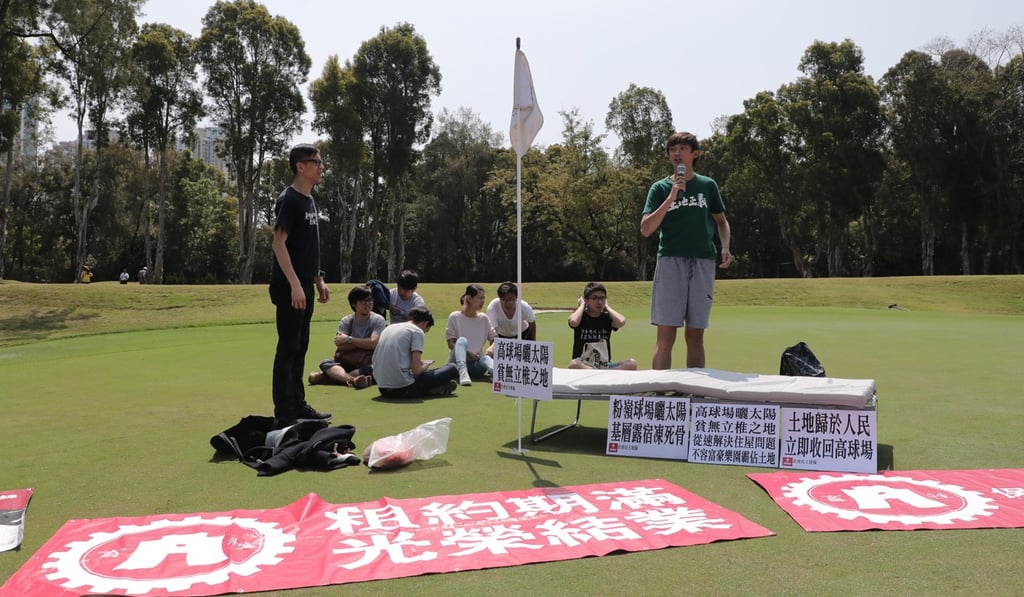
In a dramatic move to signify their strong revulsion at the setting aside of such a massive plot of land for the enjoyment of an elite sport by the privileged few, various political groups purporting to represent the underdog staged a raid on the Hong Kong Golf Club last month. Demonstrators urged the government to resume the golf courses outright, to release land for public housing.
Advertisement
Activists from the League of Social Democrats, Land Justice League and other groups stormed the Hong Kong Golf Club at Fanling, on March 31, to demand the government take back the land for housing development. Photo: Handout
Naturally, much can be said in defence of the golf courses, given Hong Kong’s long-standing policy of granting land to sports clubs by way of “private recreational lease” to enable them to provide sports facilities and promote sport development at a nominal land price. Clubs such as the Hong Kong Jockey Club and the Hong Kong Golf Club have invested heavily in maintaining world-class sports facilities, hosted prestigious international sporting events and contributed to Hong Kong’s reputation as a city with diverse sports and recreational facilities.
Advertisement
Moreover, demolition of the Fanling golf courses would risk destroying over 30,000 trees, hundreds of century-old graves of indigenous residents, historic buildings and a habitat for rare flora and fauna – the very same local treasures nativist groups have fought to preserve. Leaving aside the obvious contradictions and many deliberate factual distortions, the mounting furore over the golf land does serve as a powerful metaphor for the bitterness that has built up against the rich because of land shortages and the uneven distribution of land.