China’s monetary easing supercharges its bond market but leaves harder questions about its economy unanswered
Nicholas Spiro says the decline in China’s currency and the inconsistency in its equities market indicate limited investor confidence in Beijing’s stimulus measures and leave its main dilemma – stimulating the economy even as it deleverages – unresolved
Nicholas Spiro is a partner at Lauressa Advisory, a specialist London-based real estate and macroeconomic advisory firm.
Since the beginning of this year, there have been some sharp movements in global debt markets as the US Federal Reserve, the world’s most influential central bank, withdraws monetary stimulus at a brisker pace.
The most pronounced moves have been in short-term interest rates, which are more sensitive to changes in monetary policy. The yield on three-month Treasury bills, a cash-like instrument, has shot up more than 60 basis points to breach the 2 per cent level for the first time in a decade. The rise in US money market rates has pushed up the three-month London interbank offered rate (Libor), a benchmark for global borrowing costs, to 2.3 per cent, also a 10-year high.
Yet, while these moves are substantial, they pale in comparison with the fierceness of the price action in China’s debt markets since Beijing signalled a shift towards looser monetary policy aimed at shoring up an economy faced with the double whammy of an 18-month-old deleveraging campaign and a rapidly intensifying trade war with America.
A series of measures by the People’s Bank of China has injected significant liquidity into the financial system. Recent steps include a cut in the reserve requirement ratio for commercial banks – the second this year – in late June that unlocked over 700 billion yuan (US$101.8 billion) of liquidity and the provision of 500 billion yuan of longer-term funding in late July through the so-called medium-term lending facility, the largest such operation since the scheme was launched in 2014.
Advertisement
This easing of monetary policy, which has been accompanied by growth-supportive fiscal measures involving tax cuts and infrastructure spending, has turbocharged a rally in China’s debt markets. While Libor has risen steadily, its Chinese equivalent has fallen rapidly.
The overnight Shanghai interbank offered rate (Shibor), the benchmark for Chinese interbank markets, is down 100 basis points since early June to 1.8 per cent, its lowest level since the end of 2015. Its three-month equivalent, meanwhile, has dropped 150 basis points, to 2.8 per cent, its lowest level in nearly two years.
Advertisement
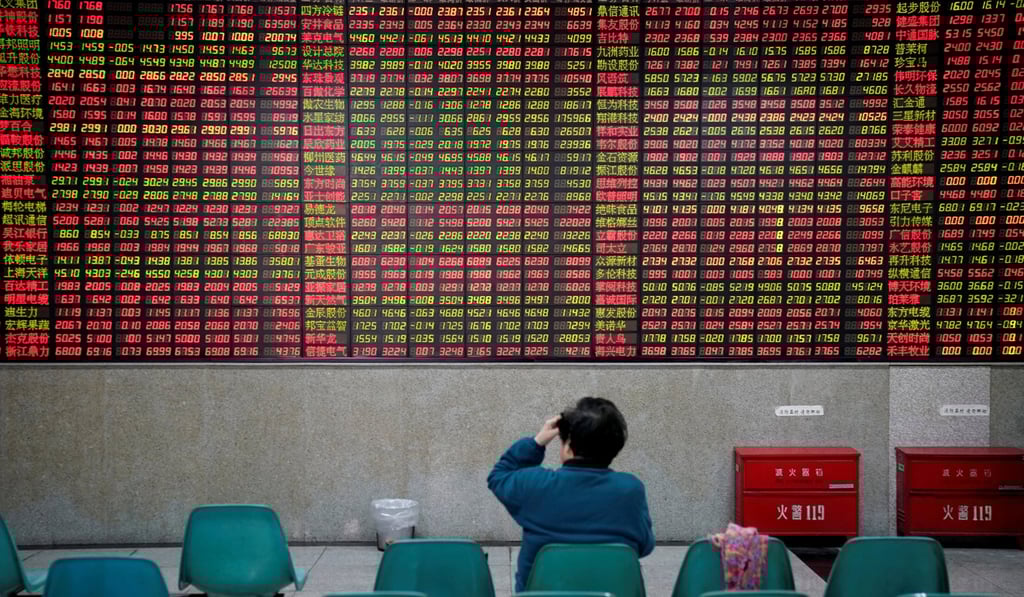
An investor looks at an electronic board showing stock information at a brokerage house in Shanghai. China’s bond market has surged even as its currency has plummeted and the Shanghai Composite Index has fluctuated wildly. Photo: Reuters
This has brought about a sharp narrowing in the gap between Chinese and US short-term interest rates. The difference between three-month US dollar Libor and its Chinese equivalent has shrunk to a mere 50 basis points, compared with 310 at the start of 2018.