
-
Advertisement
Macroscope
Opinion
Nicholas Spiro

Opinion | The US dollar will continue its triumphant run – unless central banks and the American economy change course

As long as the US economy continues to outperform its peers and central banks around the world take a more dovish stance than the Federal Reserve, the dollar will remain strong

Reading Time:3 minutes
Why you can trust SCMP
A worker displays US dollar and euro notes at a money exchange company in Peshawar, Pakistan, in August 2017. The euro is under strain from the euro-zone’s weak economy. Meanwhile, the dollar has also surged in relation to emerging market currencies. Photo: EPA
There have been quite a few surprises in financial markets this year. The US Federal Reserve, which turned increasingly hawkish last year, stunned investors in late January when it performed a dramatic U-turn in monetary policy by opening up the possibility of a cut in interest rates.

Just as surprisingly, sentiment towards emerging markets has recovered to such an extent that developing economies are now the most popular region among equity investors despite the slowdown in China, according to Bank of America Merrill Lynch’s latest fund manager survey published last month.

Another unexpected development that has received less attention is the resilience of the US dollar in the face of a dovish Fed. Since early January, the dollar index – a gauge of the greenback’s performance against a basket of other major currencies – has risen 2 per cent, leaving it just below its strongest level in almost two years.

Advertisement

The move is striking given how dovish the Fed has become – not only will it refrain from raising rates this year, it will stop unwinding its balance sheet as soon as September, effectively putting an end to policy normalisation – and how sharply US bond yields have fallen, with the benchmark 10-year yield plunging more than 70 basis points since last November.

However, exchange rates are relative and are expressed as a comparison of the performance of different countries’ currencies.
Advertisement
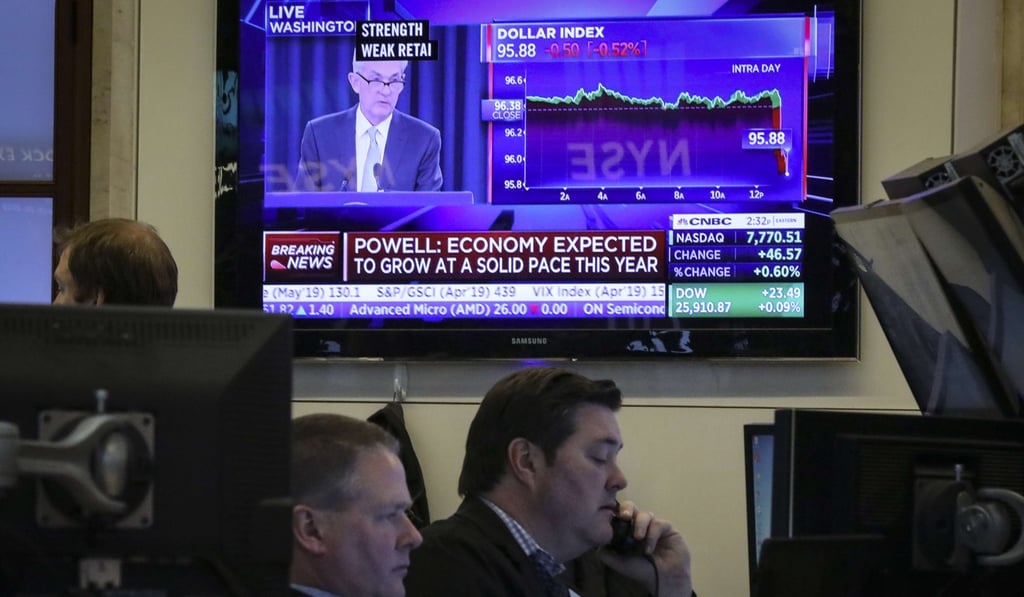
Traders work on the floor of the New York Stock Exchange as a monitor features Federal Reserve chairman Jerome Powell announcing that the central bank will leave rates unchanged on March 20. Photo: AFP
The Fed’s dovish tilt, which began in late December, was the catalyst for similar policy reversals on the part of other major central banks, notably the European Central Bank. Having ended its quantitative easing programme last December and signalled that it would start raising rates at the end of this year, the ECB reversed course last month, pledging to keep rates at historic lows and provide another round of cheap loans to euro-zone banks. While the shift in US monetary policy proved more dovish than expected, the ECB’s new stimulus measures went even further than investors had anticipated, causing the euro to fall sharply.
Advertisement
Select Voice
Select Speed
1.00x