
Advertisement
US-China trade war: Opinion
Opinion
Stephen Roach

OpinionWhy Donald Trump can’t make America great again by replicating Ronald Reagan’s script

  • Unlike Reagan who targeted Japan in the 1980s, Trump – who seeks to make China a scapegoat – has inherited a US economy with a chronically low savings rate and that is much more globally integrated
  • Without the US raising national saving, trade will simply shift from China to other countries

4-MIN READ4-MIN
Illustration: Craig Stephens

“When governments permit counterfeiting or copying of American products, it is stealing our future, and it is no longer free trade.” So said US president Ronald Reagan, commenting on Japan after the Plaza Accord was concluded in September 1985. Today resembles, in many respects, a remake of this 1980s movie, but with a reality TV star replacing a Hollywood film star in the presidential leading role – and with a new villain in place of Japan. 

Back in the 1980s, Japan was portrayed as America’s greatest economic threat – not only because of allegations of intellectual property theft, but also because of concerns about currency manipulation, state-sponsored industrial policy, a hollowing out of US manufacturing and an outsize bilateral trade deficit. In its stand-off with the US, Japan ultimately blinked, but it paid a steep price for doing so – nearly three “lost” decades of economic stagnation and deflation. Today, the same plot features China.
Notwithstanding both countries’ objectionable mercantilism, Japan and China have something else in common: they became victims of America’s unfortunate habit of making others the scapegoat for its own economic problems. Like Japan bashing in the 1980s, China bashing today is an outgrowth of America’s increasingly insidious macroeconomic imbalances. In both cases, a dramatic shortfall in US domestic saving spawned large current-account and trade deficits, setting the stage for battles, 30 years apart, with Asia’s two economic giants.
Advertisement
When Reagan took office in January 1981, the net domestic saving rate stood at 7.8 per cent of national income, and the current account was basically balanced. Within 2½ years, courtesy of Reagan’s wildly popular tax cuts, the domestic saving rate had plunged to 3.7 per cent, and the current account and the merchandise trade balances swung into perpetual deficit. In this important respect, America’s so-called trade problem was very much of its own making.

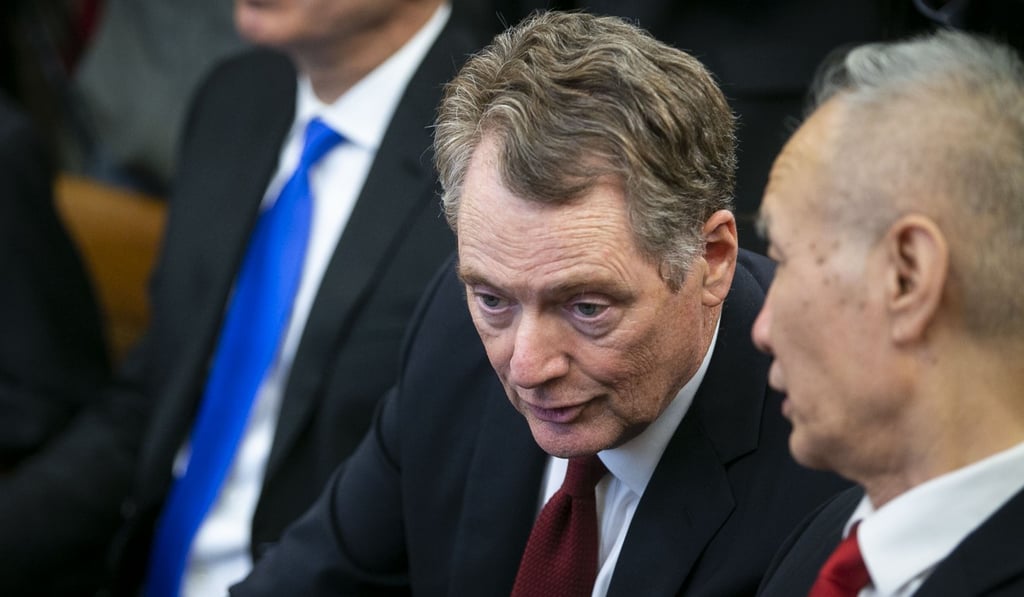
Yet the Reagan administration was in denial. There was little or no appreciation of the link between saving and trade imbalances. Instead, the blame was pinned on Japan, which accounted for 42 per cent of US goods trade deficits in the first half of the 1980s. Japan bashing then took on a life of its own with a wide range of grievances over unfair and illegal trade practices. Leading the charge back then was a young deputy US trade representative named Robert Lighthizer.
Advertisement
US Trade Representative Robert Lighthizer speaks to Chinese Vice-Premier Liu He during a meeting in Washington on February 22. Photo: Bloomberg
Advertisement
Select Voice
Select Speed
1.00x