The ViewIn Hong Kong’s trade-war-proof office rental market, it makes sense for companies to go east
- Rents in the office market remain sky-high, and companies are fleeing to Hong Kong East and Kowloon East. Although rental growth in Kowloon East has risen as a result, the district should still be more cost-effective than Central

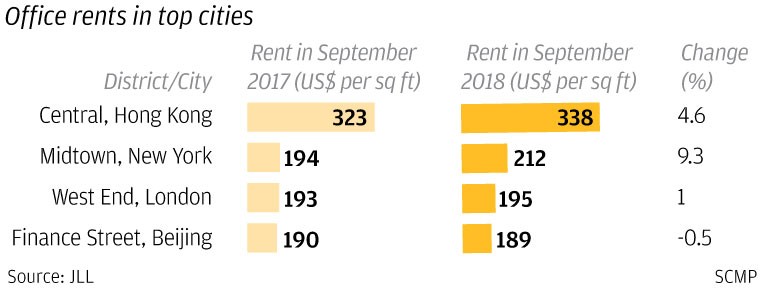
In its latest Premium Office Rent Tracker published last December, Jones Lang LaSalle, a global real estate firm, found that average total occupancy costs – the net effective rent, combined with additional costs such as taxes and service charges – for prime office buildings in Central reached US$338 per square foot per annum in the third quarter of last year.
The trend towards decentralisation is most pronounced in Hong Kong – which vies with Singapore for the mantle of Asia’s premier financial hub – where discounts between core and secondary locations are also the largest among the gateway cities tracked by JLL. According to the firm, Hong Kong East and Kowloon East, two emerging office submarkets, are respectively 64 per cent and 76 per cent more affordable than Central. This compares with discounts of 45-50 per cent for secondary markets in London and New York.