Advertisement

Macroscope
China needs to spend big, like it’s 2008 again, before the economic slowdown sets in
- David Brown says the Chinese economy needs a stronger dosage of government intervention, or growth may slow to under 5 per cent next year
- Beijing must expand the money supply, and ease credit conditions for households and companies
3-MIN READ3-MIN

David Brown is the chief executive of New View Economics.
It came like a bolt out of the blue when China’s Premier Li Keqiang recently ruled out a strong monetary stimulus to boost the economy. China can ill afford to burn its bridges, as it needs every chance to pump-prime faster growth. More fiscal spending, easier monetary policy, yuan stabilisation, faster structural reforms and better bridges with the United States are needed. Nothing should be ruled out, or China’s economic slowdown will become more entrenched, with Beijing fighting a losing battle. Without stronger intervention, sub-5-per-cent growth is definitely on the cards next year.
China needs as much stimulus as possible, from wherever it can find it, as the economy struggles to maintain momentum close to Beijing’s target of about 6.5 per cent GDP growth. Global headwinds are getting stronger, especially with pressure from the deepening trade war with the US. Current trends are not encouraging. World trade seems more hamstrung and global economic confidence is wavering. If Beijing is not careful, the slowdown could turn into a rout, posing deeper problems ahead for China’s domestic economy.
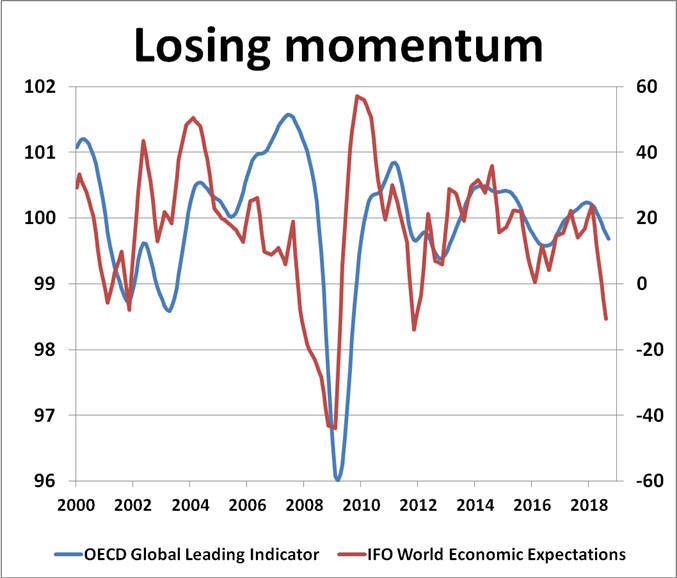
Business optimism is flagging in China, as corporate investment slows, dampening jobs growth and consumer demand. It is hard to see how Beijing can conjure up stronger growth over the next couple of years without a more balanced business plan. Most leading indicators underline that conditions are getting worse, not better.
Advertisement
Advertisement
The Organisation for Economic Cooperation and Development’s global leading index shows a worrying deterioration, an ominous warning signal of trade prospects ahead. Business optimism is being affected not just by the trade war, but also a wide range of fear factors. Political uncertainty and rate-tightening worries in the US, debt default risks in Italy, a euro crisis and a bad Brexit are just a few potential tripwires for global markets.
Advertisement
Select Voice
Select Speed
1.00x