Rising interest rates mean the US Federal Reserve is back to the fundamentals, and that’s reason to celebrate
Stephen S. Roach says the Fed tightening shows the central bank is returning to a reliance on market fundamentals, ending the era of asset-friendly easy money
I have not been a fan of the policies of the US Federal Reserve for many years. Despite great personal fondness for my first employer, and appreciation of all that working there gave me in terms of professional training and intellectual stimulation, the Fed had lost its way. From bubble to bubble, from crisis to crisis, there were increasingly compelling reasons to question the Fed’s stewardship of the US economy.
That now appears to be changing. Notwithstanding howls of protest from market participants and rumoured unconstitutional threats from an unhinged US president, the Fed should be congratulated for its steadfast commitment to policy “normalisation”. It is finally confronting the beast that former Fed chairman Alan Greenspan unleashed over 30 years ago: the “Greenspan put” that provided asymmetric support to financial markets by easing policy aggressively during periods of market distress while condoning froth during upswings.
Since the October 19, 1987, stock market crash, investors have learned to count on the Fed’s unfailing support, which was justified as being consistent with what is widely viewed as the anchor of its dual mandate: price stability. With inflation as measured by the Consumer Price Index averaging a mandate-compliant 2.1 per cent in the 20-year period ending in 2017, the Fed was, in effect, liberated to go for growth.
Advertisement
And so it did. But the problem with the growth gambit is that it was built on the quicksand of an increasingly asset-dependent and ultimately bubble- and crisis-prone US economy.
Greenspan, as a market-focused disciple of Ayn Rand, set this trap. Drawing comfort from his tactical successes in addressing the 1987 crash, he upped the ante in the late 1990s, arguing that the dotcom bubble reflected a new paradigm of productivity-led growth in the US. Then, in the early 2000s, he committed a far more serious blunder, insisting that a credit-fuelled housing bubble, inflated by “innovative” financial products, posed no threat to the US economy’s fundamentals. As one error compounded the other, the asset-dependent economy took on a life of its own.
Advertisement
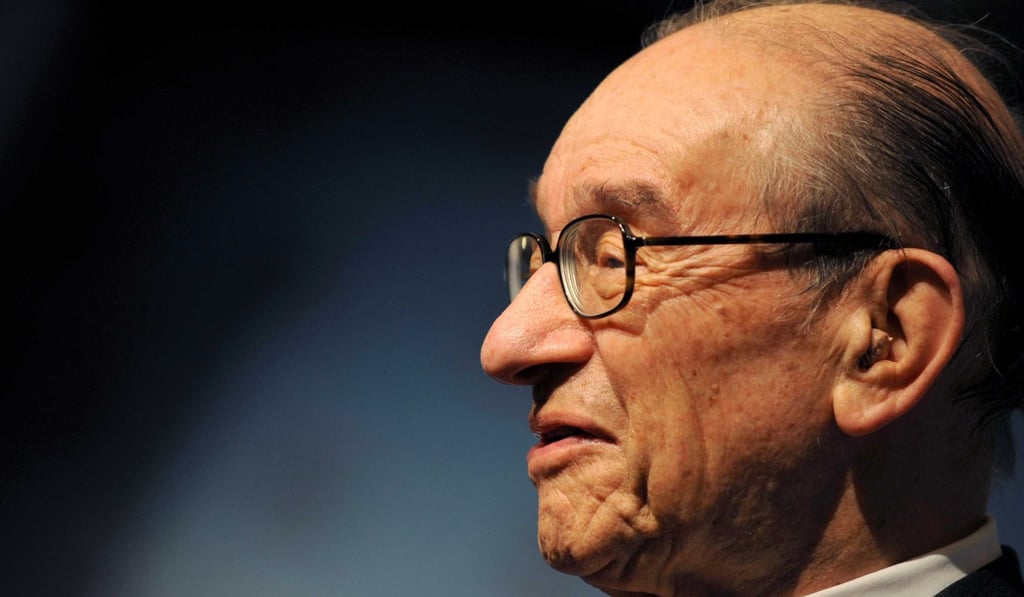
Highly regarded during his tenure of almost 19 years, former Federal Reserve chairman Alan Greenspan has since been lambasted for his ‘easy money’ policies, blamed for contributing to the housing bubble and resulting financial crisis. Photo: Xinhua
As the Fed’s leadership passed to Ben Bernanke in 2006, market-friendly monetary policy entered an even braver new era. The bursting of the Greenspan housing bubble triggered a financial crisis and recession the likes of which had not been seen since the 1930s. As an academic expert on the Great Depression, Bernanke had argued that the Fed was to blame back then. As Fed chair, he quickly put his theories to the test as America stared into another abyss. Alas, there was a serious complication: with interest rates already low, the Fed had little leeway to ease monetary policy with traditional tools. So it had to invent a new tool: liquidity injections from its balance sheet through unprecedented asset purchases.