Advertisement
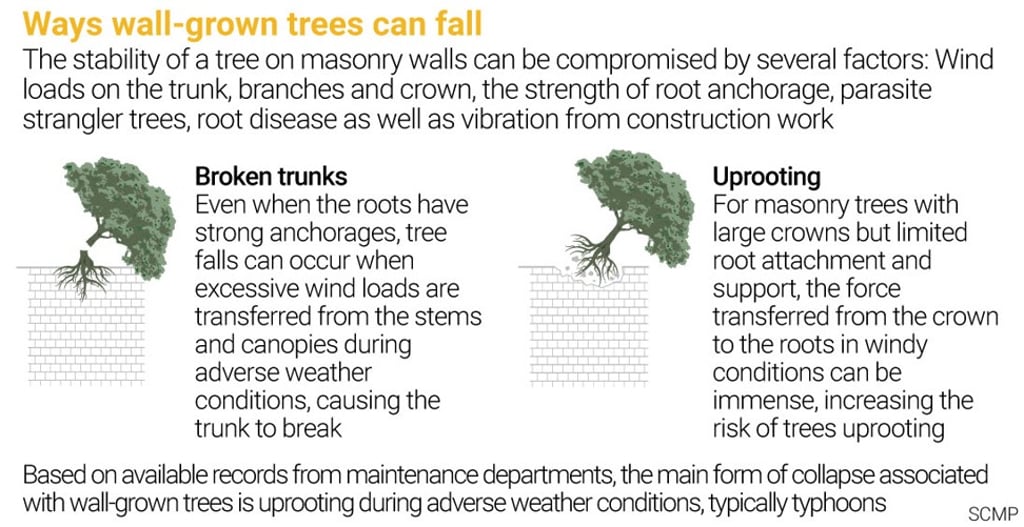
What ails Hong Kong’s old stone wall trees is a lack of communication
Reading Time:2 minutes
Why you can trust SCMP

I read with interest the article, “Review urged on safety of old wall trees” (April 30), and your editorial, “Stone wall trees need better management” (May 5).
Major hurdles for the good management of stone wall trees in Hong Kong include a lack of communication between the public and government departments, as well as some misconceptions on either side.
First, many among the general public are unaware that, before deciding to cut down a tree, an arborist has to carry out detailed inspection to prepare a report. There are three cases to be considered: (1) a healthy tree not in a “high risk to life” area; (2) a healthy tree in a high-risk area, and; (3) an unhealthy tree in a high-risk area.
Advertisement
It is obvious that to preserve trees under either cases (2) or (3) will usually incur very high cost, and the public must be fully informed of the amount and cost of the required remedial works.
Could Hong Kong’s 80-year-old banyan trees on Bonham Road have been spared?
Moreover, who is to foot the bill? So far, the general public has rarely been informed of the details and rationale of such tree reports. Therefore, it is not surprising that the cutting down of a tree of majestic heritage will cause an uproar.
Advertisement
Advertisement
Select Voice
Choose your listening speed
Get through articles 2x faster
1.25x
250 WPM
Slow
Average
Fast
1.25x