LettersSouth China Sea: harder US line towards Beijing supported by law
- China’s nine-dash line map is unreliable because of its inherent legal ambiguity and incompatibility with UNCLOS. Further, its lack of neutrality is illustrated by other claimants’ formal diplomatic protests in this dispute

Political rhetoric aside, the argument behind Pompeo’s statement regarding China’s nine-dash line is legitimate. The nine-dash line map contravenes international law, not least the United Nations Convention on the Law of the Sea (UNCLOS), in two main aspects.

03:23
The South China Sea dispute explained
Both “adjacent waters” and “relevant waters” are undefined in UNCLOS, though, so there is no specific maritime zone designated to these waters. In other words, since the map’s legal terminology does not cohere with the legal definitions in UNCLOS, China’s legal assertions in the South China Sea that are underpinned by the map have no lawful effect.
Second, maps do not constitute titles in international law. Scholars such as Florian Dupuy and Pierre-Marie Dupuy have noted that “cartographic materials do not by themselves have any legal value”. This legal principle was validated by the judgment given by the International Court of Justice on the Frontier Dispute case between Burkina Faso and Mali in 1986.
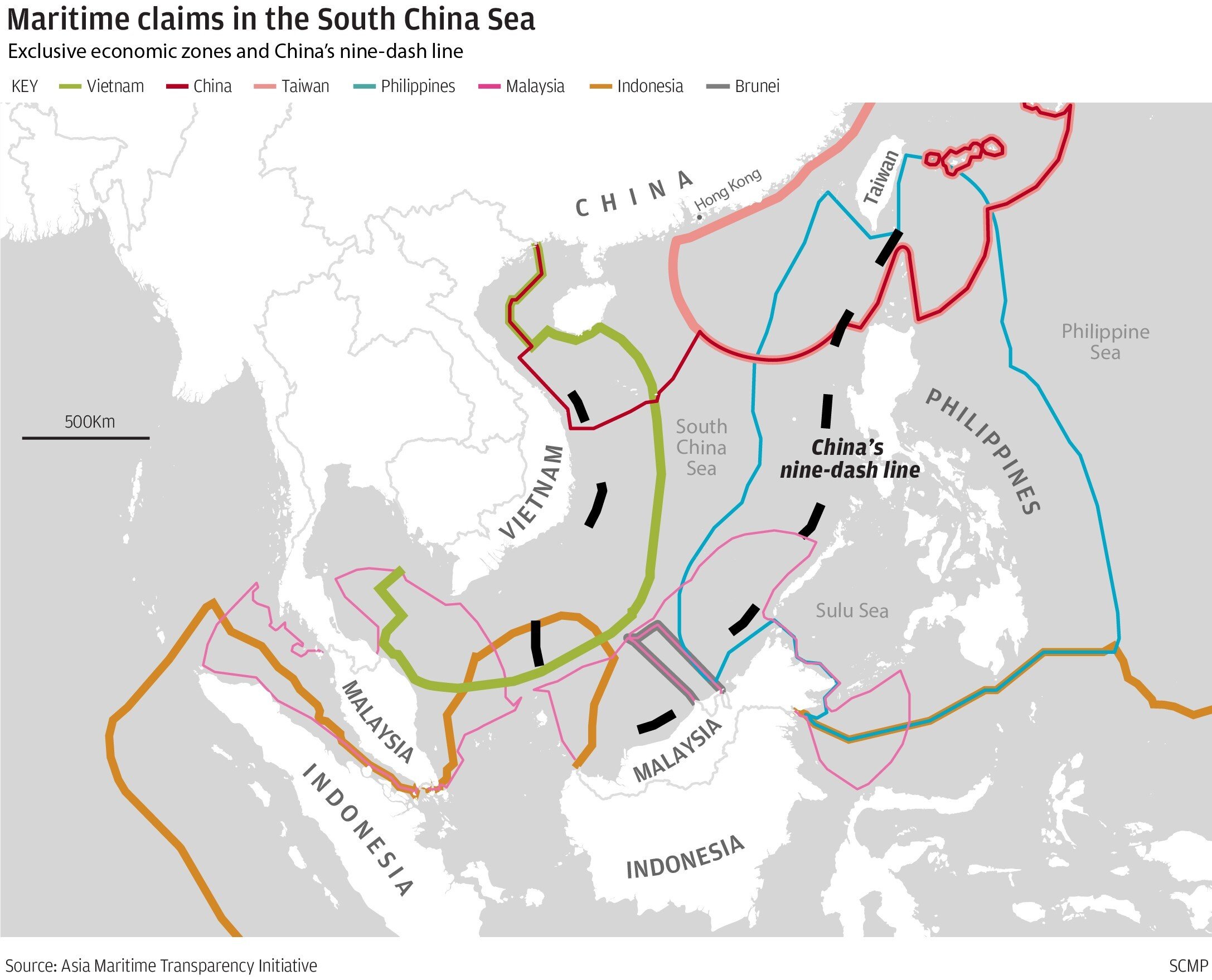
According to the court, “maps merely constitute information, and never constitute territorial titles in themselves alone.” Furthermore, while maps can be employed “to establish the real facts,” their value depends on both “their technical reliability and their neutrality in relation to the dispute and the Parties to that dispute.”