
-
Advertisement
Macroscope
Opinion
David Brown

Europe must ignore naysayers, including the US, and loosen the fiscal and monetary purse strings to stave off recession

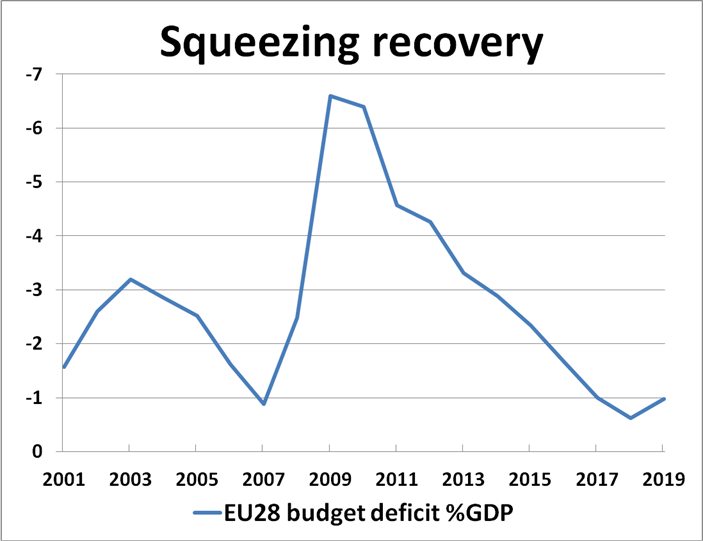
  • Europe’s emphasis on austerity and fiscal stabilisation since the global financial crisis is not working. With a recession and no-deal Brexit looming, it’s time for the ECB and European governments to loosen the strings

3-MIN READ3-MIN
European Central Bank President Mario Draghi (right) chats to then-US Federal Reserve chair Janet Yellen and Bank of Japan Governor Haruhiko Kuroda in August 2017, in Jackson Hole, Wyoming. Policy harmonisation between major economies would be ideal, but in the meantime there’s much Europe can do on its own to stimulate its economy. Photo: Kyodo
Europe stands at a crossroads. Economic growth has stalled and recession is on the cards. Without a quick fix, Europe’s sputtering economy could soon descend into the same deflationary daze that has dogged Japan for many years. A new round of monetary easing has already begun but it may not be the best option for Europe any longer.

Even the European Central Bank’s monetary hawks are beginning to balk. A new policy direction is needed. It’s time Europe dumped austerity measures and adopted more aggressive fiscal solutions to jump-start a recovery. Europe’s populist politicians may be right about needing to spend their way out of a recession. 

The ECB has already started Europe’s monetary presses rolling again, pushing interest rates deeper into negative territory and ready to print more money under an extended quantitative easing (QE) programme to boost growth. The economy is crying out for extra help, with economic confidence failing, business activity beginning to fold and, critically, Germany already halfway into another recession.
Advertisement

If Germany slips into negative growth again, Europe is in deep trouble. The omens seem bad considering the US-China trade war and a potential no-deal Brexit looming.

The ECB’s new monetary manoeuvres are not without their problems, with reports suggesting that a sizeable minority on the ECB policy council are opposed to what is an already super-loose monetary strategy. In a disturbing development last week, German ECB member Sabine Lautenschlaeger resigned from her position as an ECB executive board member in apparent opposition to any further easing.
Advertisement
Source: New View Economics
Advertisement
Select Voice
Select Speed
1.00x