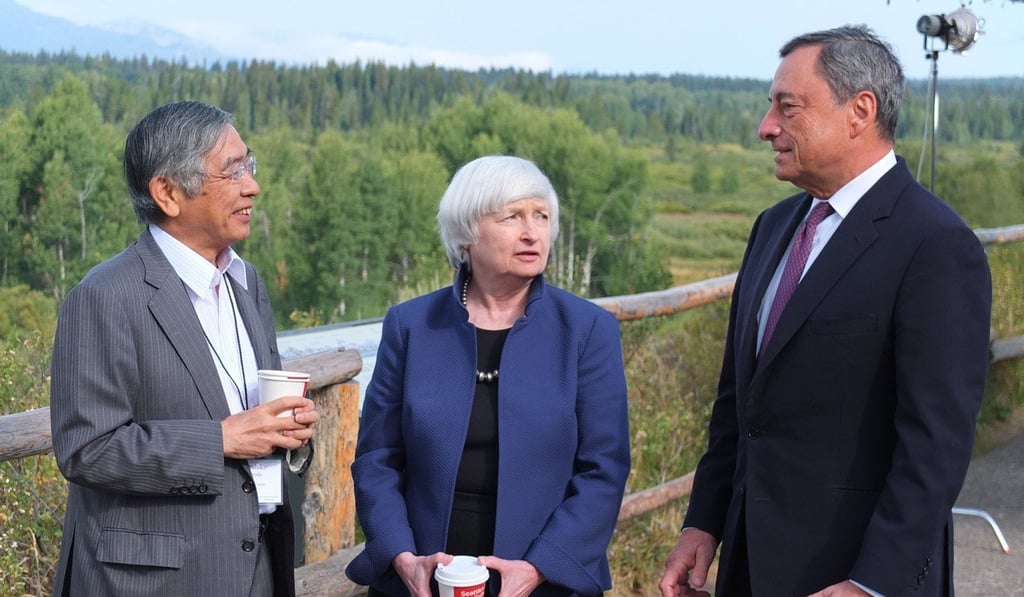
For the cause of the next financial crisis, look to central banks’ overextended balance sheets
- Assets of the US Federal Reserve, European Central Banks and Bank of Japan stand at 3.5 times their pre-crisis level
- Protectionism, populism and political dysfunction could provide the trigger that tips vulnerable global markets into crisis

Predicting the next crisis – financial or economic – is a fool’s game. Yes, every crisis has its hero who correctly warned of what was about to come. And, by definition, the hero was ignored (hence the crisis). But the record of modern forecasting contains a note of caution: those who correctly predict a crisis rarely get it right again.
The best that economists can do is to assess vulnerability. Looking at imbalances in the real economy or financial markets gives a sense of the potential consequences of a major shock. It doesn’t take much to spark corrections in vulnerable economies and markets. But a garden-variety correction is far different from a crisis. The severity of the shock and the degree of vulnerability matter: big shocks to highly vulnerable systems are a recipe for crisis.
In this vein, the source of vulnerability that I worry about the most is the overextended state of central bank balance sheets. My concern stems from three reasons.