
-
Advertisement
Macroscope
Opinion
David Brown

As trade tension recedes, Trump’s re-election bid will set the battleground for US dollar bulls and bears

  • The positive impact of a trade deal with China will outweigh the downside risks of a potential conflict in the Gulf, leaving domestic politics to play a key role in whether market confidence in the US dollar will hold

Reading Time:3 minutes
Why you can trust SCMP
A man talks on his mobile phone in front of a currency exchange bureau advertisement showing images of the US dollar in Cairo. The dollar has had a good run for its money over the past few years on the strength of the “Trump effect”. Photo: Reuters
This could prove a challenging year for currency pickers, with possibilities ranging between the good, the bad and the ugly. On the bright side, the US-China trade war should come to a close fairly soon, ending most of the uncertainty which has dogged the global economy in the past few years.

But the worry is that the trade rift has dealt economic confidence such a heavy blow that global recovery will fail to reignite spontaneously. And, if the world is staring into the jaws of another Gulf war and an associated spike in oil prices, then all hell could break loose for investors in the coming months. It could easily turn into a battleground between dollar bulls and bears.
The crisis between the US and Iran could not have come at a worse time, with global business conditions already fragile. Hopefully, diplomacy will prevail, both sides will back off and more serious conflict can be avoided. The threat of higher energy prices is not good news, especially with global manufacturing indicators still showing major economies struggling to come to terms with the US-China trade war.
Advertisement
The US factory slump deepened in December with the Institute of Supply Management manufacturing index contracting for a fifth straight month, its weakest performance in more than 10 years. European manufacturers are continuing to have a tough time, too.
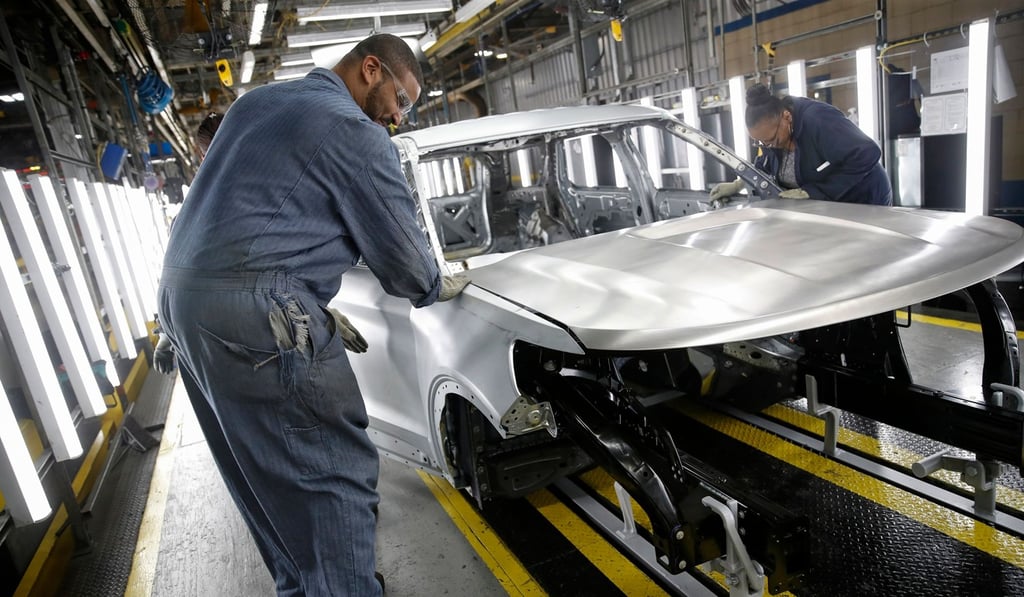
Workers assemble cars at a Ford plant in Chicago in June 2019. The US manufacturing sector contracted for the fifth straight month in December, hitting its lowest point since June 2009, according to an industry survey released on January 3. Photo: AFP
Advertisement

Despite the usual tendency to seek refuge in the dollar when global risks are rising, potential cracks in the US economic outlook could be one reason why investors might be a little more dollar-cautious this time.

US Federal Reserve policymakers have already signalled that interest rates are likely to stay steady at 1.5 to 1.75 per cent through to the end of 2020 and even the risk of stagflation (slower growth and higher inflation) is unlikely to change things. If anything, the Fed will be more worried about the downside risks to growth and more inclined to ease policy again if need be. Relative interest rate perceptions will be a lot less dollar-supportive.

Advertisement
Select Voice
Choose your listening speed
Get through articles 2x faster
1.25x
250 WPM
Slow
Average
Fast
1.25x