
Advertisement
China economy
Opinion
David Brown

Macroscope | Should Germany follow China’s ‘dual circulation’ strategy?

  • Beijing has ample scope to achieve 6 per cent growth in the coming years, but Germany, dependent on trade with its European Union partners, has poorer prospects
  • Germany could take its cue from China’s new gambit to turn inwards and focus on domestic-led recovery to thrive

Reading Time:3 minutes
Why you can trust SCMP
3
Women walk past a popular shopping mall in Beijing, on October 19, 2020. China’s economic recovery from the coronavirus pandemic is gaining strength as consumers return to shopping malls and auto dealerships. Photo: AP
This year will be a tale of two economies; we could see very different outcomes for growth in China and Germany, the world’s two leading export surplus nations. Economic confidence is rising, global growth is accelerating and world trade is picking up, providing grand opportunities for both countries after last year’s pandemic-driven downturn.

The world is in catch-up mode right now, but the key question is whether stronger recovery will be sustainable beyond 2021. China is turning its policy bias inwards towards greater domestic-driven growth, but Germany’s economy is still too dependent on its export-led growth model and vulnerable to a number of outstanding risk factors. Beyond 2021, we could see some marked divergence between these two manufacturing powerhouses.

Global demand is gradually responding as world health authorities get on top of the Covid-19 vaccination programme, the threat of pandemic recedes and economic conditions finally begin to normalise. The global supply chain is well behind schedule, and there is massive pent-up demand for consumer and capital goods, minerals and raw materials.
Advertisement

As leading exporters, China and Germany have a clear head start. March forecasts from the Organisation for Economic Co-operation and Development expect global growth to reach 5.6 per cent in 2021, with China hitting 7.8 per cent and Germany growing more modestly by 3 per cent. Faster export recovery will be the driver, especially for China where exports surged by 60.6 per cent for the January-February period compared with a year ago.
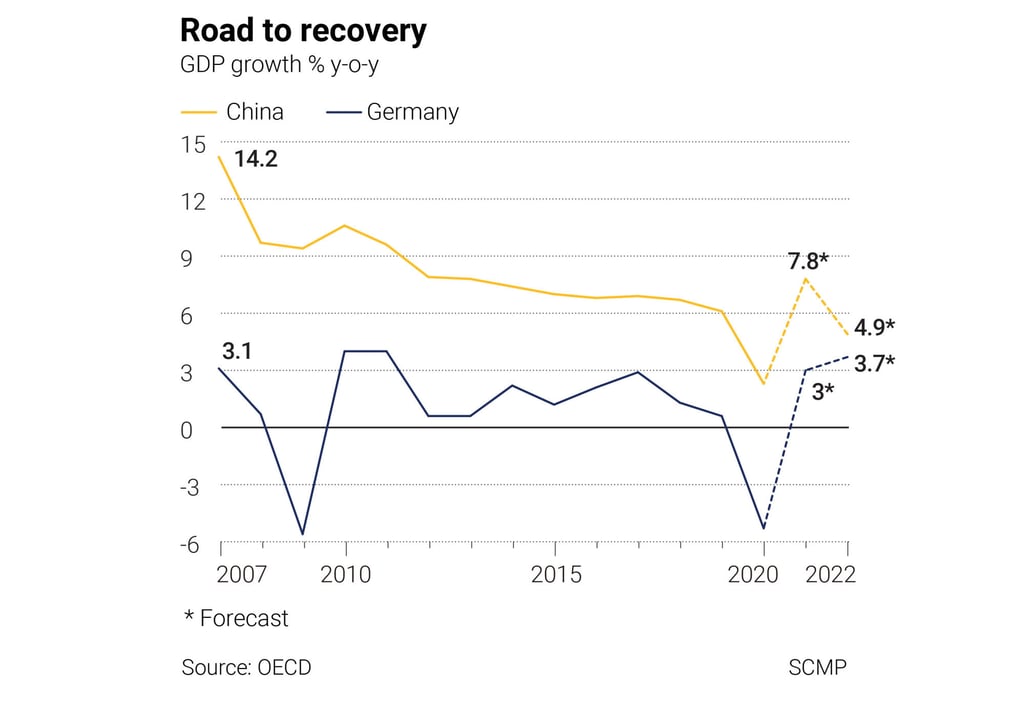
Looking ahead, the post-pandemic rebound is bound to be moderate as global demand conditions settle down and world trade begins to normalise. But it’s not likely to upend growth expectations in China too much, with Beijing planning to protect its economy from volatile global factors with its new “dual circulation” strategy, making the best use of external market conditions to promote faster domestic-led growth at home.
Advertisement
Since 2007 up until the start of the Covid-19 crisis last year, China had managed to sustain average annual growth at around 8.5 per cent, providing Beijing with ample scope to achieve a soft landing of 6 per cent growth trend in the next few years. The OECD’s March interim projection for 4.9 per cent growth in 2022 seems way too pessimistic considering Beijing’s policy bias towards more sustainable domestic recovery ahead.
Advertisement
Select Voice
Choose your listening speed
Get through articles 2x faster
1.25x
250 WPM
Slow
Average
Fast
1.25x