The ViewWhy London’s bruised office market is still luring Asian investors
Asian buyers have spotted opportunities to acquire London assets at a critical moment – the price correction is entering its final stage and competition from other buyers will intensify when central banks start to loosen policy
Signs that commercial property remains out of favour with investors are plain to see. The S&P Global Reit Index, a gauge of real estate investment trusts in developed and developing economies, is down about 33 per cent since the beginning of 2022. Global commercial property transaction volumes in the first three-quarters of this year plunged to their lowest level in more than a decade, according to JLL data.
The sharp deterioration in sentiment stems from a confluence of strong headwinds. The two blowing the hardest are the lingering effects of the Covid-19 pandemic and the dramatic rise in interest rates. While the accelerated shift to remote working has crimped demand for office space and put the quality and sustainability of buildings under scrutiny, the surge in the cost of debt has struck valuations and driven up landlords’ expenses.
Commercial property, in particular offices, has become a dirty word in financial markets. In Bank of America’s October global fund manager survey, respondents deemed commercial real estate in the US and Europe to be the most likely source of a systemic credit event.
Advertisement
The UK has been hit hard by the double whammy of the pandemic and rising rates. According to the findings of a survey by Morgan Stanley of office markets in the UK, US, Germany and France published last week, Britain experienced the sharpest rise in remote working since the pandemic began. Office workers are working from home an average of 2 days a week, compared with 1.7 in the US.
In London, one of the world’s biggest office markets, leasing volumes in the first three-quarters of this year were 21 per cent below the equivalent period in 2022 and 15 per cent below the average for the first three-quarters during the past 10 years, according to JLL data. The vacancy rate, moreover, has shot up from 4 per cent at the end of 2019 to 9.6 per cent.
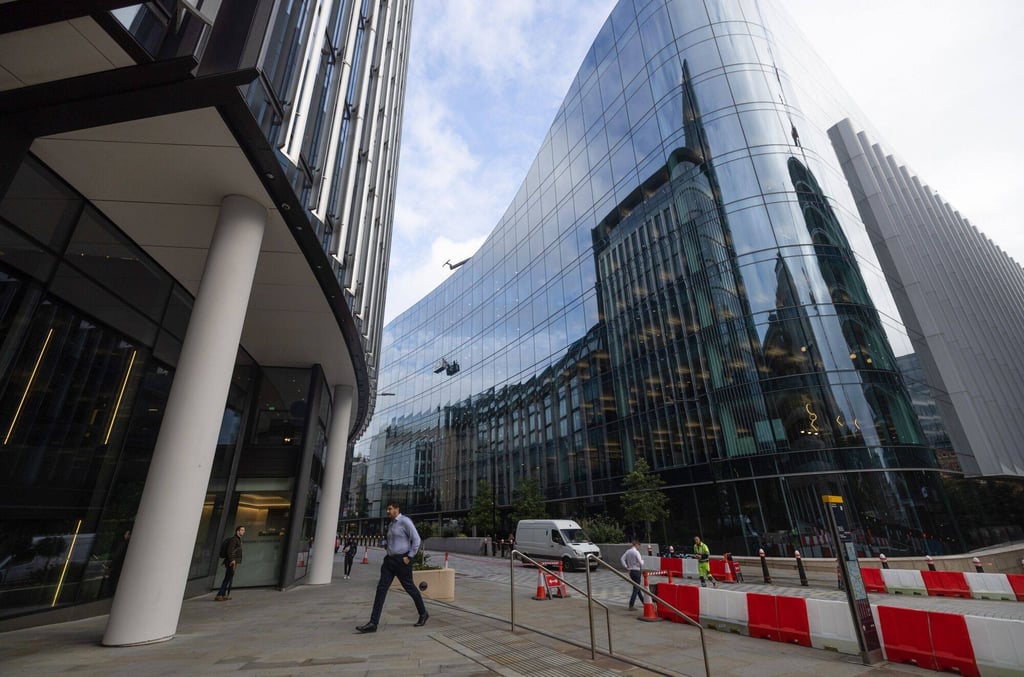
Commercial office buildings in London on October 25. UK office workers are working from home an average of 2 days a week, compared with 1.7 in the US. Photo: Bloomberg
The investment market has shrivelled. In the UK as a whole, offices have accounted for just a quarter of investment activity this year, down from more than half a decade ago, according to CBRE data. Even so, while demand has taken a hard knock, Asian investors have spotted opportunities to acquire assets at a critical moment for London’s office occupier and investment markets.