How therapy dogs help with learning disabilities, anxiety and other health problems, whether you’re young or old
- Animal-assisted therapy helps slow learners catch up, coaxes young recluses to re-engage with society, and relieves loneliness and dementia in the elderly
- In Hong Kong, guide dogs that haven’t made the grade become therapy animals, with Labradors the chosen breed because they are obedient and eager to please

Six-year-old Helios Tang is deep in thought as he plots his next move on a wooden cognitive training puzzle. He is also very happy – he’s with his favourite therapy dog, Isla.
His mother, Edith Chan, says he was about two-and-a-half when teachers first became concerned about his progress. “His speech was not at the same level as other kids and he was also very shy,” she says. “I was told it was GDD, global developmental delay.”
GDD is the broad term to describe delayed cognitive and physical development in children, which covers motor skills, speech, and social and emotional development.
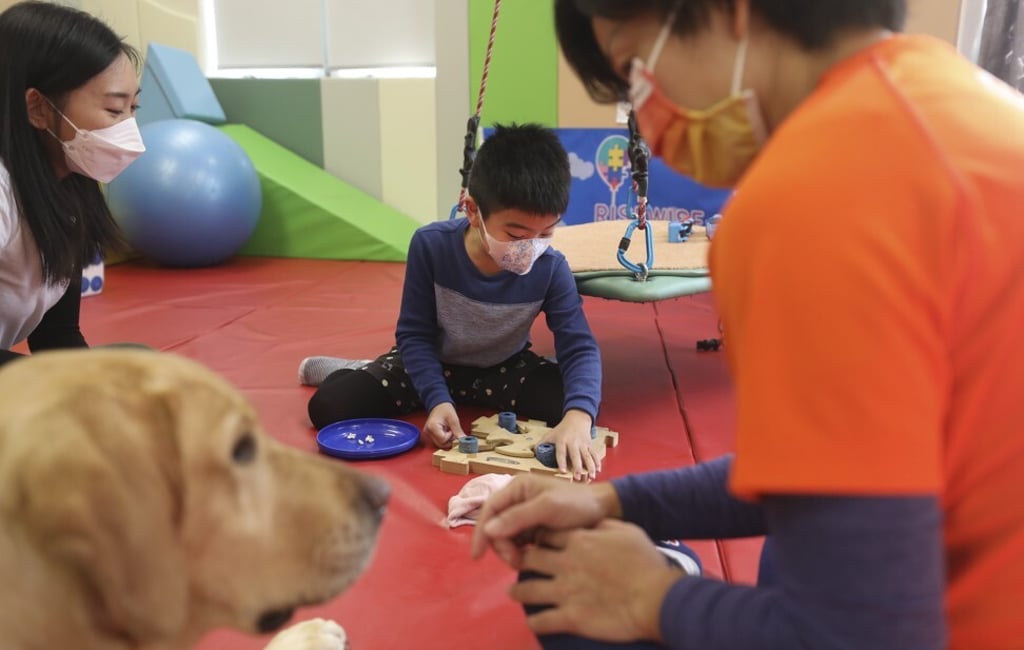
For the past seven months, Tang has taken part in an animal-assisted intervention (AAI) programme at Rise Wise, a child development centre based in Hong Kong’s Central district. It recently partnered with the Hong Kong Guide Dogs Association to provide tailored one-on-one and group programmes for children with special needs.
Today Tang is at the association’s dog training centre in Kwun Tong, East Kowloon, for one of his two-hour weekly sessions.