Advertisement
Asia travel
LifestyleTravel & Leisure

Five ways to explore Singapore’s Peranakan culture, from food to architecture, homewares and hand stitched slippers

Descendants of the city’s Straits-born Chinese left their mark, even if only traces remain today of a rich creole culture

Reading Time:3 minutes
Why you can trust SCMP
Peranakan shophouses in Singapore’s Katong neighbourhood. Photo: Darren Soh/ Singapore Tourism Board.
Jamie Carter

Today only traces remain in Singapore of one of the world’s most precious creole cultures, but the city state is at last making efforts to preserve and showcase what’s left.

Straits-born Chinese – the Peranakan (which means “born of”) – are largely the descendants of Chinese immigrants who came to Singapore in the 17th century and married local women. The Peranakan culture, a hybrid southeast Asian culture of Chinese, Malay and Indian influences, also has esoteric Portuguese, Dutch and Indonesian traces.

Advertisement

Assimilation may have dulled its character as a distinct modern culture, but there are Peranakan touches all over Singapore, particularly in its food and architecture – as long as you know where to look.
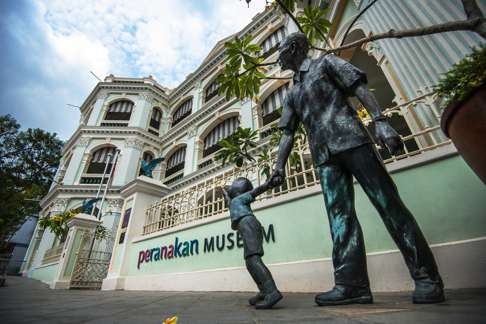
The Peranakan Museum, Singapore. Photo Afur Wong/Singapore Tourism Board.
1. Visit the Peranakan Museum
Advertisement
A good place to begin seeking a deeper understanding of the Peranakan culture is at this museum (39 Armenian St, peranakanmuseum.org.sg). Though many in Singapore claim Peranakan heritage, it’s a hard culture to pin down, and the museum’s explanations are helpful; the umbrella term is revealed as including not only Peranakan Chinese – often called “baba” and “nonya” – but also Chitty Melaka (descended from Hindu traders) and Jawi Peranakan (descended from Indian Muslims).
Advertisement
Select Voice
Choose your listening speed
Get through articles 2x faster
1.25x
250 WPM
Slow
Average
Fast
1.25x