Accordionist on changing China’s perceptions of the instrument and its debt to Chinese sheng
Lithuania’s Got Talent winner recalls personal journey from prodigy to international accordion-playing fame – just don’t call it a squeezebox

Freedom’s child I was born in Taurage, a small town in the west of Lithuania, in 1990, just when the country was gaining its independence from the Soviet Union. I’m very proud to be the freedom boy. My mother was a single mother, she works as a cook, and I don’t have any siblings. I remember tapping my fingers on the table when I was three and telling everyone I was playing the piano – I was copying someone I’d seen on TV. My family didn’t have the money to buy a piano so I was given a small child’s accordion instead. No one taught me how to play. I just learned by myself from the age of three, playing the instrument by ear.
Hitting the right note When I was eight, we heard about an accordion teacher in Šiauliai, in northern Lithuania, so we moved there to be close. After so many years of just playing what and how I pleased, I found lessons difficult. I was taught how to place my hands correctly, the theory of music – I hated it and ignored much of my practice. Then, after two years, something clicked. Of course, it helped that my teacher was really inspiring and believed in me. I also had piano lessons, but the piano never excited me as much as the accordion.
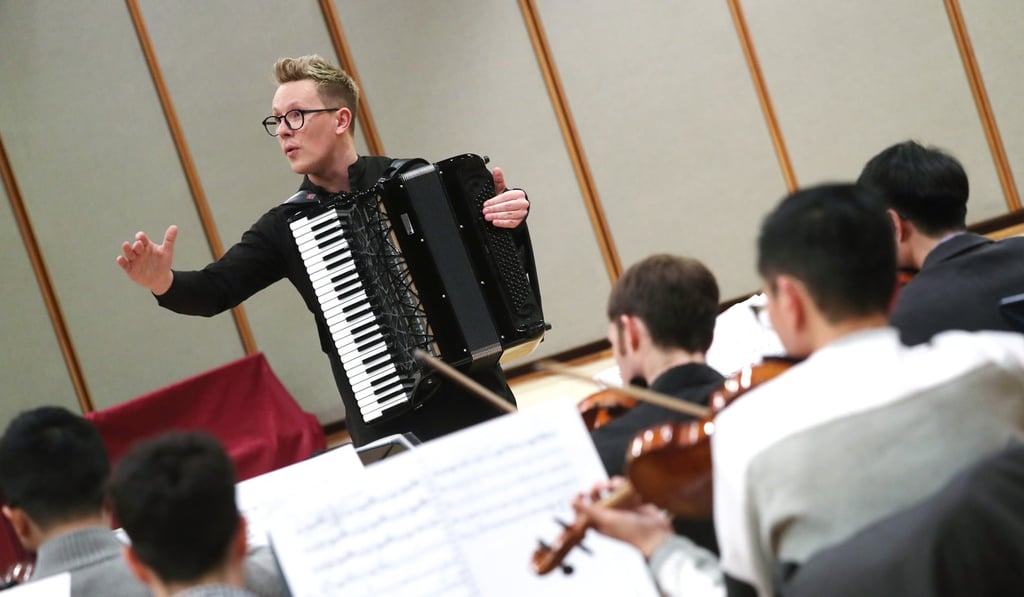
I toured 16 cities in China. It was interesting and challenging – the audience talked and filmed the performance, and even played it back – but I think it was worth doing and the audience was a little changed after they left the concert
There are a few kinds of accordion and I play the piano accordion. The accordion was patented in Vienna in 1829, so it’s ironic, with all the city’s classical composers, that none were around to see this beautiful instrument. Mozart himself wrote letters to instrument makers asking them to make an instrument that would be portable, could sustain sound for a long time and could play polyphonic music. It’s a shame he didn’t live long enough to experience this instrument. I like to think of the Chinese instrument known as the sheng – a mouth organ that is played by blowing through a mouthpiece in the side – as the first prototype accordion. It has been around for more than 2,000 years.
A turn at Ronnie Scott’s When I was nine years old, I played for almost 300 people on a stage with musicians who were 16 and 17. It was really exciting and it was then that I realised I love being on stage. My teacher used to say, “The bigger the audience, the better you play.” At the age of 13, I started preparing for really serious competitions and that meant I had to practise a lot in the summer holidays. I would stay at my teacher’s house for a few months over the summer. I couldn’t play football or hang out with my peers – I just practised really hard. I look back fondly on those summers.
My first trip abroad was to Italy, when I was 13, for a competition. Since then, I’ve won more than 30 prizes and awards. Competing is different from concert performing: it’s more about absolute accuracy and the competition, and performing is more about the artistic integrity, and you communicate with the audience. In 2008, I entered the Royal Academy of Music in London. It’s the only place in England that supports the study of the accordion. I’d had quite a sheltered life up until then, so it was exciting to be in London discovering things and being around musicians. I met a few musicians who had a slot at Ronnie Scott’s and they invited me to play with them. Although Ronnie Scott’s is a jazz club, they’re quite open and we played mostly African and Latin-influenced music.