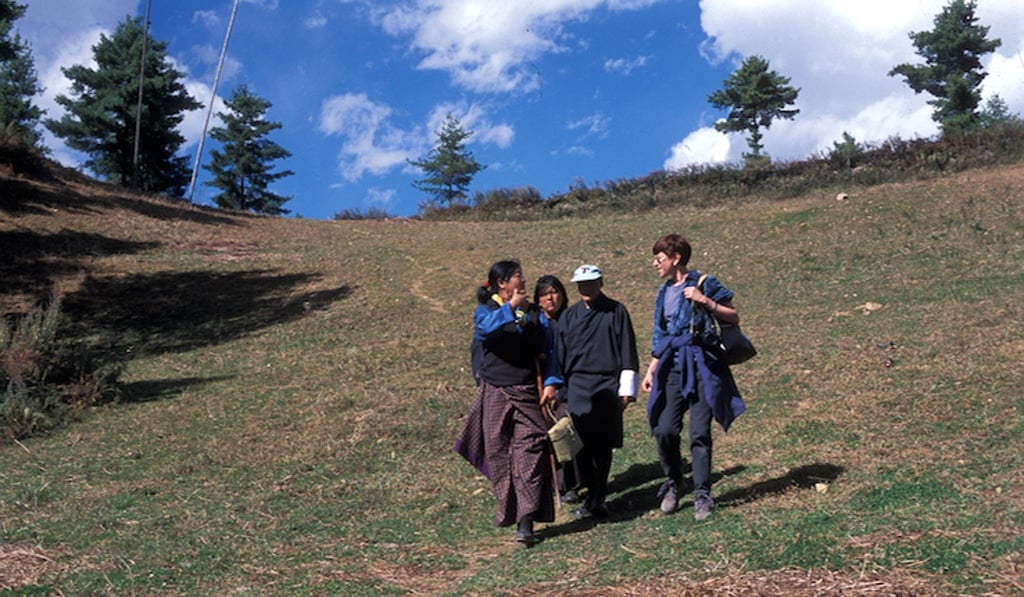
She helped put Bhutan on the cultural tourism map, and she can’t stop smiling
- A chance invitation to French ethno-historian Françoise Pommaret to visit the Himalayan kingdom in 1981 led to her making Bhutan her home
- There, she has contributed to its development as a magnet for discerning tourists

African adventure My grandparents on my mother’s side were Corsican and, like many Corsicans living in France, they weren’t well off. The only way out of that was to join the civil service in the colonies, so my grandfather went to the Congo with my grandmother. My mother was brought up there and met my father, who went there as a civil engineer. They married and, when I came along, their first child, they decided to return to France to have me because the hospitals in the Congo were not good.
I was born in 1954 and, when I was six months old, my parents returned to the Congo with me. I grew up in the capital, Brazzaville, and went to school there with my younger brother. I was exposed to other cultures at a young age and that has had a big influence on my life. As a young child, the Congo was a colony and I lived a middle-class, colonial family life. But then came independence and that’s when things got interesting.
In thrall to China I was 11 when the Congo government turned towards China. At the peak of the Cultural Revolution, the government was under the influence of the Chinese and became very anti-colonial. The phones were monitored, everything was monitored. During morning assembly in school we sang (left-wing anthem) The Internationale and then had to shout, “Down with the French colonialists!”
I did well academically. Because I was top of my class, I would have to apologise to my school for coming from a privileged class and having better opportunities. I quickly learned it was just a play to please the authorities, so I didn’t mind.
Karma chameleon When I was 17, I went to university in France. I did three degrees in four years – first a BA in Latin and Greek, then a BA in history and archaeology, and then, because I’d had a passion for Asia since I was young, a degree in Tibetan studies. In 1974, after graduating, I went to Asia for the first time. I travelled around Nepal and found Tibet interesting. I didn’t fall in the Buddhist pot. I was interested in the culture, but I didn’t realise at the time how much Buddhism was a part of it.