Why more wealthy Chinese aspire to a socialite lifestyle – and why Western luxury brands should take note

In China’s top-earning families, it has become more frequent for children to learn horseback riding and rowing – sports usually associated with aristocratic families
Today, the word “aristocracy” means different things to different people. To Western societies that promote inclusivity, it sounds culturally backward. But to many in China, it can simply mean having big ambitions. In 2017, Jing Daily interviewed Sara Jane Ho, who founded one of China’s first etiquette schools: Institute Sarita. Her US$10,000 weekly etiquette course for China’s nouveau riche – with a syllabus featuring lessons on how to pronounce luxury brands correctly and how to cut bananas with a fork – was a success. Two years later, the country’s appetite for socialite etiquette training has only grown.
But for these elites, the vision of becoming a refined global citizen is the ultimate goal
In September 2019, Tian Pujun, the wife of China’s largest property developer Wang Shi, rose to Weibo’s top search with the article “Three Generations Cultivate an Aristocrat,” which was published in a popular Chinese magazine. In the article, she states: “I think China lacks good education, as most Chinese possess knowledge but no culture.”
She emphasised her point by sharing a story about a party she attended at a British aristocrat’s villa where the concierge shared the owner’s Wi-fi code with her by bringing it to her on a silver platter. While this example might seem over the top in many settings, Tian’s articulation of Chinese citizens’ bad manners has galvanised many within China’s upper class. Tian is also the founder of Chengli Academy, a finishing school which teaches high-society survival skills such as table manners, horseback riding and inheritance management to China’s super-rich. The academy also arranges networking trips with British aristocrats and top American families such as the Rockefellers. The annual tuition, according to the Chinese media site Sohu, costs around US$140,000.
While Tian’s academy is an extreme case, etiquette has been a rising trend with China’s top-earning families. In the country’s wealthiest families, it has become more frequent for children to learn horseback riding and rowing – sports usually associated with aristocratic families. “Yacht dinner” frequently pops up in wealthy millennials’ club conversations, even though China has never had a tradition of leisure boating activities. Meanwhile, in high-end tourism, travel itineraries offering socialite experiences or workshops in cities such as Paris and London have been trending for years now.
Guillaume Rué de Bernadac is one of China’s most famed etiquette trainers. He tapped into the country’s zeitgeist for high culture and self-improvement through his Académie de Bernadac; an institute offering classes in upper-class manners and savoir-vivre. In an interview with Jing Daily, he describes his clientele as mainly “Chinese ladies from age 25 to 50, curious, global and playful.” The academy’s three most popular courses are table manners, deportment (how to walk and stand elegantly) and photo posing. Because of the demand, Rué de Bernadac just recently launched a three-day programme called “Elegant Goddess Divine Deportment”, which, according to the agenda, allows pupils to learn how to walk and stand with poise, match jewellery with hats properly and perform well in front of the camera. At the moment, the class costs around US$990. Beyond coaching individuals, Rué de Bernadac has also worked with luxury brands, including Cartier and Gucci, by holding etiquette sessions for the brands’ VIP clients.
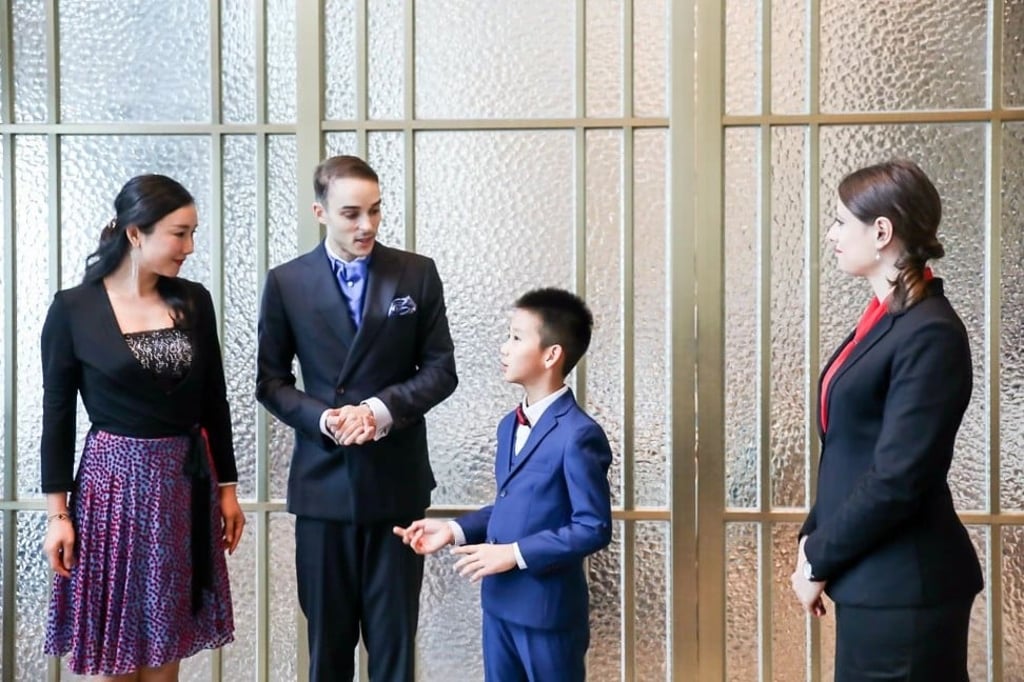
To Rué de Bernadac, the growing appetite for acquiring Western manners comes from a place of wanting to adapt to a global society rather than submitting to Western ideals. “My clients are proud of China and being Chinese, but they also want to feel confident, fit in a global environment and make others feel comfortable,” Rué de Bernadac states.
My clients are proud of China and being Chinese, but they also want to feel confident, fit in a global environment and make others feel comfortable
Yingying Li, founder of the consultancy firm Yingfluencer and host of the podcast “How China Works”, believes the phenomenon can be explained by Maslow’s hierarchy of needs, a psychological theory that ranks human needs in order of necessity. She points out that, on a cultural level, the current stage of Chinese consumption is at an “esteem needs” level, which implies there’s a need to spend more and feel a sense of prestige or accomplishment.