Who are China’s top influencers and key opinion leaders by commercial value?

New report examines the effects of key opinion leaders to determine what makes for good, bad, and high potential celebrity-brand collaborations
This article was written by Rachel Zheng and originally published in Jing Daily.
Are influencers and KOLs (key opinion leaders) effective promoters of brands or just of themselves? This is the question at the heart of a new study by Bomoda, a New York-based consumer intelligence company. In its 47-page report, “2017 Bomoda China Key Opinion Leader Index: Understanding Celebrity Influence”, it examines 400 Chinese celebrities active on various social media platforms in the first half of 2017, whittled down from a list of 40,000 of the most mentioned names on social media), to demystify the effect of KOLs and to try to determine what makes for good, bad, and high potential celebrity-brand collaborations.
“Ideally,” Bomoda CEO Brian Buchwald told Jing Daily in a phone interview, “a brand wants a celebrity who will have the positive effect of bringing their own direct audience with the added value of being highly photographed and picked up by third-party accounts”.
In today’s influencer-filled digital landscape, as brands see more success from working with self-made bloggers converting their own fan economy into influence with brands, the benchmark of commercial return has become higher, and many brands are reassessing their influencer strategy, wondering if costly traditional celebrity endorsements still work. And it’s not always easy to gauge the impact of celebrity endorsements. Some KOLs have a lot of buzz, according to Bomoda, but that doesn’t necessarily translate to brand awareness. On the other hand, some KOLs understand how to shape their fans’ perceptions of those brands.
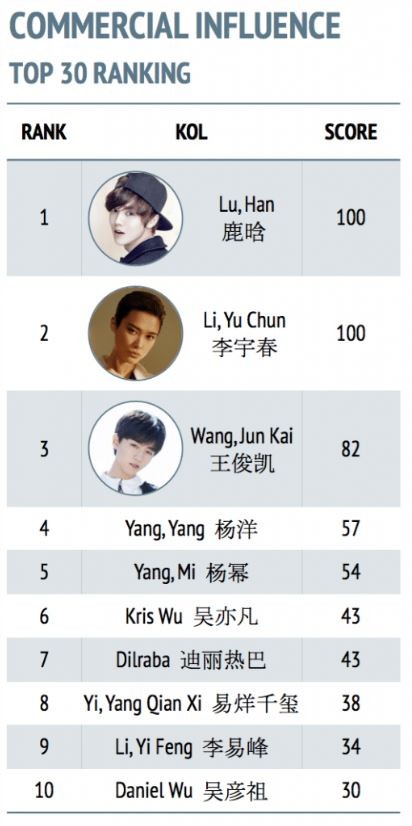
In examining over 51 million Weibo posts, 2.3 billion related re-posts and comments, and over 2.4 million WeChat articles, Bomoda attempts to figure this out. The report is divided into two sections. In the first, it examines performance by social and commercial influence. Then it lists the top KOLs in five industries, such as activewear, consumer electronics, food and beverage, high-street fashion and luxury fashion. In the second section, it looks at KOLs with “high potential”, and, in the adverse, those with “low brand/product influence.”
Here are a few key takeaways from the report.
A celebrity’s commercial value must be measured against her social influence
The report looks at effectiveness through two lenses: social influence and commercial influence. The commercial value measures the KOL’s ability to persuade her fans to consider buying a brand’s products and the percentage of Daigou or third-party sellers who leverage the celebrity endorsement to attract purchases. In this list, Lu Han, the star of Louis Vuitton’s recent campaign for the launch of its smartwatch, came in first. Yang Yang (4), Yang Mi (5), and Kris Wu (6), were also in the top 10.