From ‘old’ Celine to ‘new’ Dior – what luxury fashion brands do China’s millennial girl bosses prefer?

Young, rich and empowered, China’s growing generation of ‘alpha female’ founders and CEOs seek to balance strength, grace and ‘ambition without the feminist filter’
This article was originally written by Jiaqi Luo for Jing Daily
Despite a deep-seated patriarchal culture, China is one of the world’s top countries when it comes to executive gender equality. It now has the world’s highest proportion of women working in senior management positions, the second-largest percentage of female CEOs, and a full half of the world’s self-made female billionaires.
In an age of unbridled aspiration, an increasing number of Chinese women are changing the country’s business landscape – and its tastes in luxury in the process. Ambitious and image-conscious, this new generation of Chinese women in charge is probably luxury brands’ best target, yet it’s also their most ignored.
Female founders in China are in a very fortunate position – even when compared to western women, they are more open to talking about ambition without the feminist filter
Although female entrepreneurship is a rising phenomenon worldwide, China’s unique social conditions have made the “girl boss” identity particularly attractive. First, entrepreneurship is a glorified concept in China today. There’s never been a time or place where so much emphasis has been placed on financial success and personal achievement, and as a result, the social pressure to be a “founder” among the millennial generation is huge.
Second, media representations of “alpha female” characters have been proliferating over the past few years, which has contributed to Chinese women’s expectations to “want it all.” Among the most influential TV role models are Andi from Ode to Joy, the CFO of an investment firm who returns to China after studying in New York; Su Mingyu from All is Well, a self-made woman whose look contributed to China’s women’s suit trend earlier this year; and Tang Jing from The First Half of My Life, a workaholic who prioritises work over relationships. These on-screen characters have epitomised the ideals of successful women in China today, which means being ambitious and capable while also looking gorgeous.
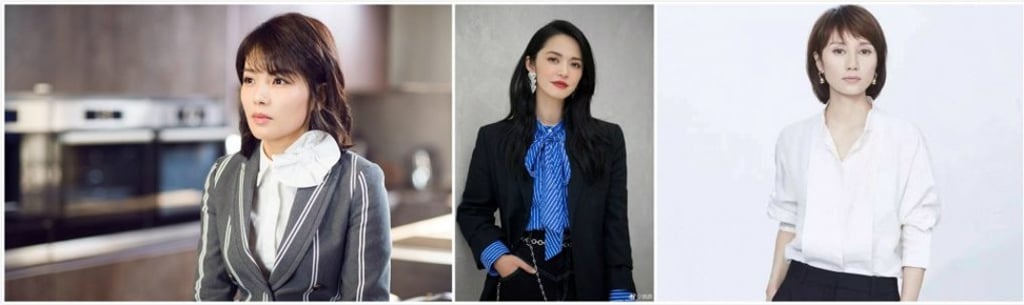
According to a 2017 report co-issued by the business site 36kr and the non-profit female entrepreneur network GirlUp, the typical profile of a female Chinese founder largely overlaps with one of a classic luxury consumer. They are mostly millennials born between 1985 and 1990, overwhelmingly come from the country’s most developed first-tier and second-tier cities, and almost half of them were educated overseas (another aspect pointing to a common background of privilege).
Amy Wu, the founder of GirlUp, said that China’s enthusiasm for female entrepreneurship is higher than it’s ever been. “I think female founders in China are in a very fortunate position in Asia,” she said. “Even when compared to western women, they are more open to talking about ambition without the feminist filter.”
While the #MeToo movement ushered in a new order of political correctness in the workplace, that ethos has yet to extend to China. The phrase #MeToo is still periodically banned from Chinese social media, and messages containing overt feminist claims are repeatedly taken down by internet censorship. The mix of a conservative social climate and a rise in female entrepreneurship has created a complicated scenario for Chinese women today. On one hand, they want to dress to look self-assured and in power, but on the other, they still need to look feminine and adhere to their society’s rigid beauty standards.
As a consequence, femininity remains an important quality for Chinese girl-boss fashion.
“By and large, Chinese women in power dress much more femininely than compared to the West,” said Zhuorui Fu, the globetrotting female CEO of her eponymous Zhu Studio brand. “Sometimes I do spot gender-neutral looks in Shanghai’s start-up scene, but it is very rare.”
Similarly, GirlUp’s Wu repeatedly pointed to the term “柔美róu měi,” which means “morbidezza” or a delicate, graceful beauty, as a way to describe the ideal appearance of Chinese girl bosses.