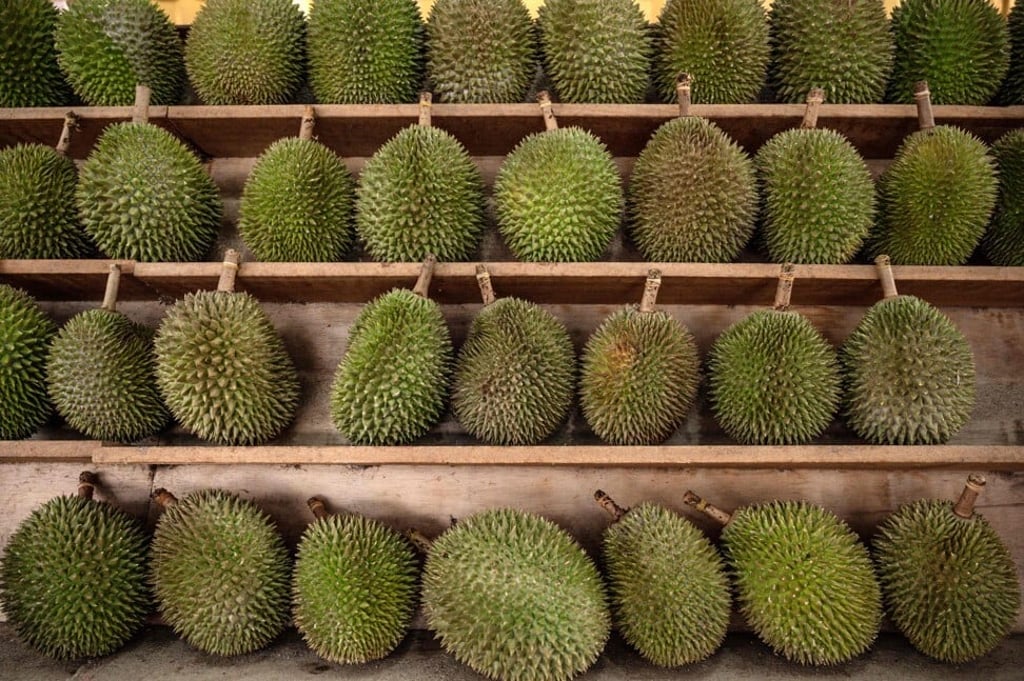
Why China loves durian, the smelly fruit popular in Thailand, Singapore and Malaysia but banned in hotels and on public transport in many countries across Asia

Love it or hate it, the prickly, room-clearing ‘king of fruit’ isn’t going anywhere – Malaysia’s limited edition Cadbury Dairy Milk Durian is back by popular demand, and China imported US$1.7 billion of the fruit last year alone
Arguably the most prized of all produce in Southeast Asia, the durian is famed for its prickly outer shell, soft, yielding custard texture and an intense flavour that somehow combines sweet, savoury and creamy all at once.
Given its name by the 19th century British naturalist Alfred Russel Wallace, the durian is known as the “king of fruit”, even if its sulphur compounds mean you smell it long before you see it. And gourmands and connoisseurs the world over adore the divisive taste so much that the highest quality durians are enthusiastically sought after.
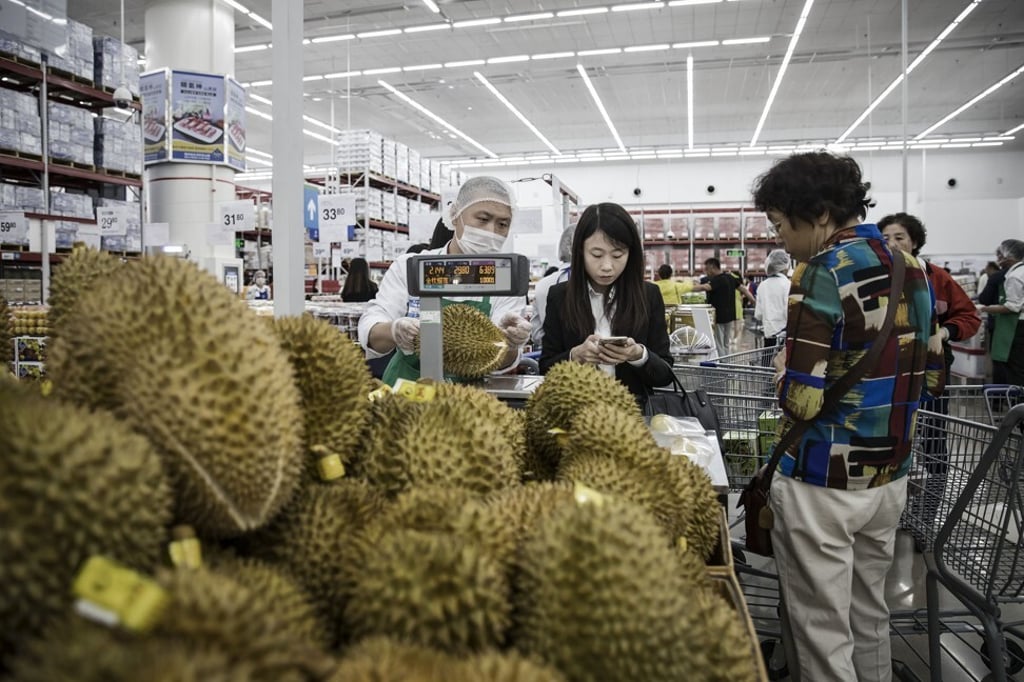
As if to prove the point, in early October 60 tonnes of Mao Shan Wang (also known as Musang King) durians – about 300,000 in total – were sold in under an hour as part of the 2020 China-Malaysia durian festival. Their particular draw – in contrast with varieties such as D24, Red Prawn and Black Pearl – is the combination of sweet and bitter flesh in one fruit, meaning a surprise for the eater as only on taking a bite can you know what lies in store.
The online extravaganza of the 2020 China-Malaysia durian festival, held in Qinzhou city in China’s Guangxi region, celebrated the beloved fruit in all its multiple forms and saw some remarkable sums change hands. Almost US$15 million was paid for those 60 tonnes of thorny Mao Shan Wang durians alone.
The headline-grabbing transaction was just the tip of the iceberg, however. The Malaysian prime minister’s special envoy to China, Datuk Seri Tiong King Sing, revealed statistics showing the much bigger picture.
In 2019, China imported 7,700 tonnes of frozen durian pulp and paste worth US$67 million. Not only that, but durian also plays a key role in smoothing bilateral trade between China and Malaysia.
This year, Covid-19 has had a significant impact on durian prices, as it has had with economies and levels of agricultural production around the world. Happily, however, with China’s situation rapidly improving, Malaysian durian exports have now reached almost 80 per cent of usual volume, according to Malaysia Food Farmers Association president, Francis Hong.
This positive outlook was echoed by Shi Ziming, the commercial counsellor at China’s embassy in Malaysia, who told The Star in Malaysia that durian demand in China was still strong, remaining popular with Chinese consumers purchasing the fruit as gifts for families, friends and business associates.