First person charged under Hong Kong’s national security law will stand trial at High Court, with no cap on sentencing
- The prosecution’s decision to try the case at the High Court means defendant Tong Ying-kit will face the full weight of the controversial law
- Sentences under the legislation run up to life imprisonment, with a minimum of 10 years in severe cases

The first person charged under Hong Kong’s controversial national security law could be facing a very long stretch behind bars if convicted, after prosecutors moved his case to a higher court with no sentencing cap.
Defendant Tong Ying-kit was brought to West Kowloon Court for the second time on Tuesday, three months after he was held on remand for allegedly violating the Beijing-imposed legislation at a protest on July 1, the day after the sweeping law came into effect.
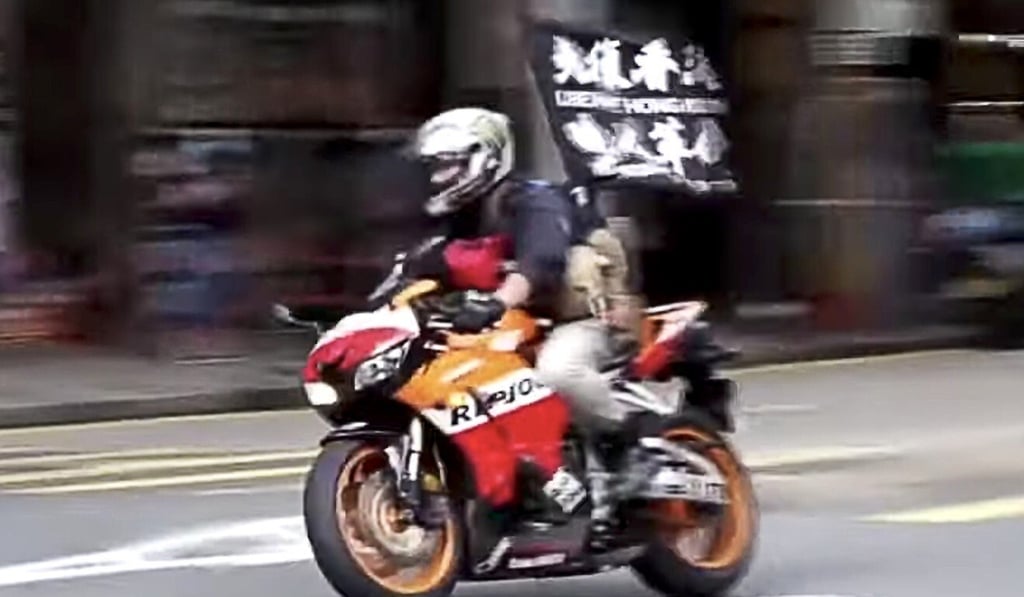
The 23-year-old was accused of riding his motorcycle into a group of police officers that day while carrying a flag bearing the popular protest slogan “Liberate Hong Kong; revolution of our times”. Three constables were said to have suffered serious injuries in the incident.
Prosecutor Anthony Chau Tin-hang applied on Tuesday to move the trial to the High Court – where sentencing is not subject to any restrictions – instead of the lower District Court and magistrates’ courts, where the maximum jail sentences are capped at seven years and two years, respectively.
Serious cases heard by the High Court under the city’s common law system typically involve trials by jury, but the national security law empowers the secretary for justice to request a trial by a three-judge panel instead on the grounds of protection of state secrets, involvement of foreign entities, or the protection of the personal safety of jurors and their family members.
The Post was told the justice department had yet to determine whether to allow jurors to preside over the trial.