How an iceberg’s ‘final dance’ tells a story about our past and future
One of the biggest icebergs in recent memory is melting out of existence. Its silent fate mirrors the neglect of our biosphere

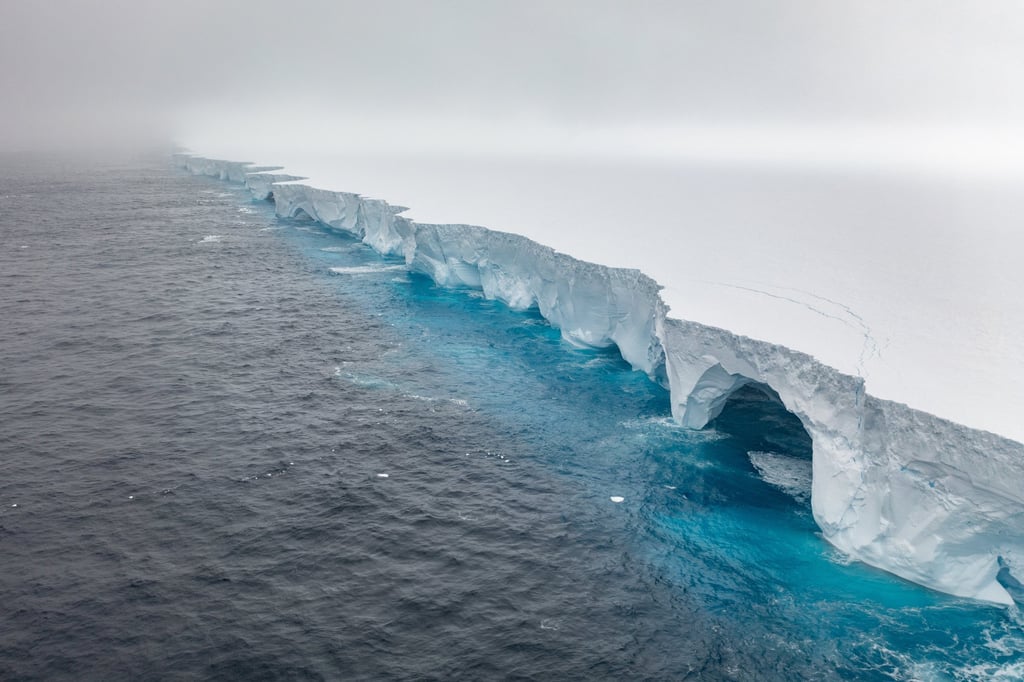
A23a was one of the largest “megabergs” to be spawned in our lifetimes. When it broke away from the Filchner Ice Shelf into the Weddell Sea in Western Antarctica in 1986, it covered an area of around 4,000 sq km – about the size of Hong Kong and Shenzhen combined.
In contrast to such stars, A23a has led a reclusive life, twisting and turning unnoticed across the South Atlantic. For its first 30 years, it was jammed in the Weddell Sea in Western Antarctica, a major source of the continent’s big icebergs. But then A23a was caught in “Iceberg Alley” and carried up to South Orkney. From there, it was roiled in a giant rotating vortex called the Taylor Column. It spun on the spot for eight months, but eventually broke north towards South Georgia, which is the graveyard for most of Antarctica’s icebergs.
By the start of 2025, A23a was still a colossus. It would have been far too large to squeeze through the space between the island of Taiwan and the mainland Chinese continental coast.
But as it has travelled further north towards warmer parts of the South Atlantic, nature has relentlessly taken its toll. Over the past few months, it has sweltered through the South Atlantic. As of a few months ago, according to Professor Mike Meredith at the British Antarctic Survey in Cambridge, A23a “was getting pretty mushy and wasn’t going to live long”.