Advertisement
Climate change
This Week in AsiaHealth & Environment

More attention at COP28 urged for ‘vulnerable’ mountain range spanning Nepal, China, India

  • Pema Gyamtsho leads the Nepal-based ICIMOD that seeks to establish a higher-level institutional mechanism for regional cooperation on climate change issues
  • While wealthy governments are expected to help lower-income countries, the latter should also be responsible and be wary of their infrastructure projects

Reading Time:4 minutes
Why you can trust SCMP
A child swims through a flooded street after Yamuna River overflowed due to monsoon rains in New Delhi. From record-breaking heatwaves to floods and landslides, the Hindu Kush Himalaya region has witnessed some of the worst climate-related disasters in recent memory. Photo: AFP
Bibek Bhandari

There are an estimated 54,000 glaciers in the Hindu Kush Himalaya region, and they are melting at an unprecedented rate. Glaciers in the region could lose up to 80 per cent of their current volume by 2100 as temperatures rise significantly, a June report by the International Centre for Integrated Mountain Development (ICIMOD) warned.

From record-breaking heatwaves to floods and landslides, the Hindu Kush Himalaya region has witnessed some of the worst climate-related disasters in recent memory. And as world leaders and policymakers prepare to gather at the 28th United Nations Climate Change conference, or COP28, in Dubai from November 30 to December 12, experts are calling for swift actions to tackle the crisis.

“Now is the only window of opportunity for us to take firm and immediate, urgent actions,” said Pema Gyamtsho, director general of ICIMOD, an intergovernmental environmental institution headquartered in Kathmandu. “Science must influence policymakers with the urgency that the actions need to be taken at a pace and scale that is probably unprecedented in the past.”
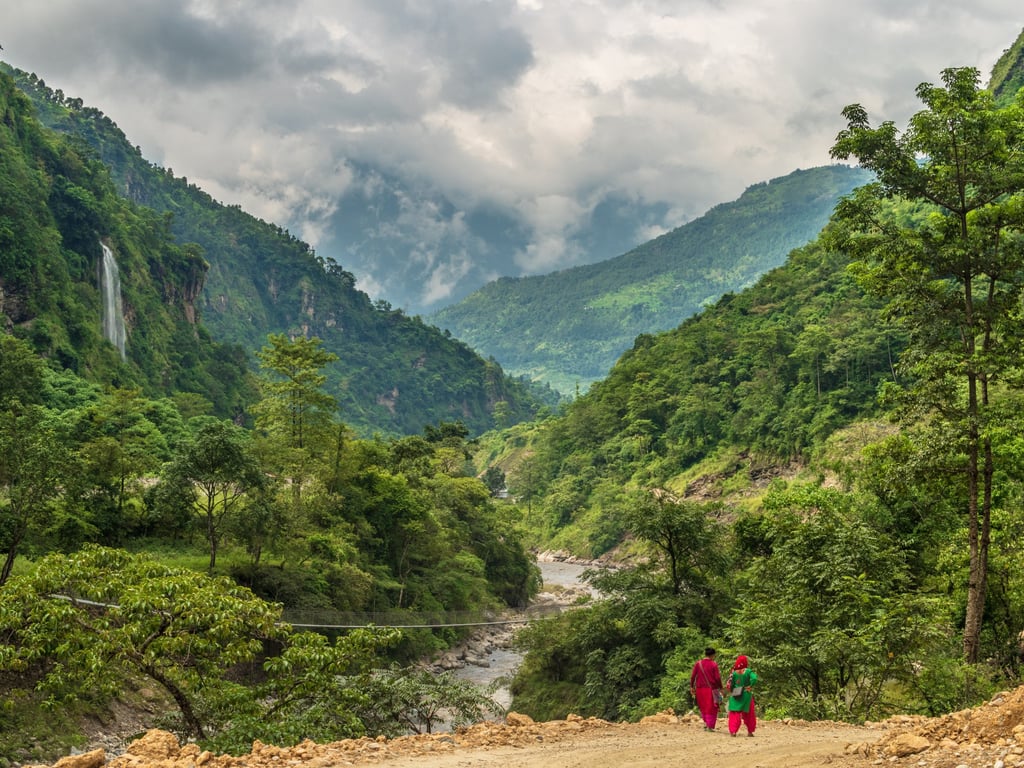
The western Himalayas in Nepal. Known as the “pulse of the planet”, the Hindu Kush Himalaya region spans 3,500km (2,175 miles) across Afghanistan, Bangladesh, Bhutan, China, India, Myanmar, Nepal and Pakistan. Photo: Shutterstock
Known as the “pulse of the planet”, the Hindu Kush Himalaya region spans 3,500km (2,175 miles) across Afghanistan, Bangladesh, Bhutan, China, India, Myanmar, Nepal and Pakistan. But rising temperatures have accelerated the expansion of existing glacial lakes and created new lakes, resulting in frequent glacial lake outburst floods.
Advertisement
A flash flood earlier this month killed at least 77 people in the mountainous Indian state of Sikkim after it was triggered by a glacial lake outburst. The devastating landslides in the states of Himachal Pradesh and Uttarakhand, as well as floods in Afghanistan, Bhutan, Myanmar and Nepal, have led to several deaths and wide-scale destruction during this year’s monsoon season.

At COP28, Gyamtsho said all the Hindu Kush countries had to collectively send a message about the vulnerability of the region. He called for the need to increase investment and technology transfer to tackle the crisis.

Advertisement
“This region is at the receiving end of the impacts of climate change,” he said. “We need to sensitise the global community, the Global North, about the uniqueness and vulnerability of this region.”
Advertisement
Select Voice
Choose your listening speed
Get through articles 2x faster
1.25x
250 WPM
Slow
Average
Fast
1.25x