Advertisement
China’s military
This Week in AsiaOpinion
Cary Huang

Sino File | China’s National Day show of military muscle risks backfiring

  • The sheer amount of weaponry on display was meant to strengthen nationalism at home, while sending a message to the US and Taiwan
  • But in doing so, Beijing has undermined its efforts to improve relations internationally, and could spark an arms race among its regional rivals

Reading Time:5 minutes
Why you can trust SCMP
28
A Guard of Honour formation marches in the October 1 parade in Beijing marking the 70th anniversary of the founding of the People’s Republic of China. in Beijing. Photo: Xinhua
China’s military parade on October 1 – one of the largest in human history – to observe the 70th anniversary of the communist republic’s founding was largely aimed at a domestic audience. But the bigger impact of the massive display of Chinese military hardware was on the world stage, particularly on its neighbours and the US-led West, whether it was intended or not.

In the first place, the primary political message of the pomp and pageantry was to underline China’s fast rise to being a global power, from what was a poor and weak country just decades ago, and the party’s role in fostering it.

The grandeur was also meant to triumphantly celebrate the model of technocratic authoritarianism and state capitalism China has upheld, in resistance to calls from within and outside the country for the introduction of a universally accepted free market and liberal democracy, as Beijing sees global liberalism as losing some ground, if not legitimacy.

It was President Xi Jinping’s second military parade in four years, something no party leader since Mao Zedong had attempted to stage. The propaganda-filled parade was also designed to underscore Xi’s absolute grip on power and his unique status paralleling that of Mao, the founding father of the republic. Xi has already had this status enshrined in the party charter and state constitution. The message Mao proclaimed was that “Chinese stood up in the world”, while Xi has pledged to lead the Chinese people to “stand on the top of the world”.
Advertisement

Indeed, the anniversary came amid revived celebration of Mao’s ultra-leftist doctrines and policies, ideological indoctrination campaign, revolutionary-patriotic songs, and a return to the Mao-style cult of personality surrounding Xi.
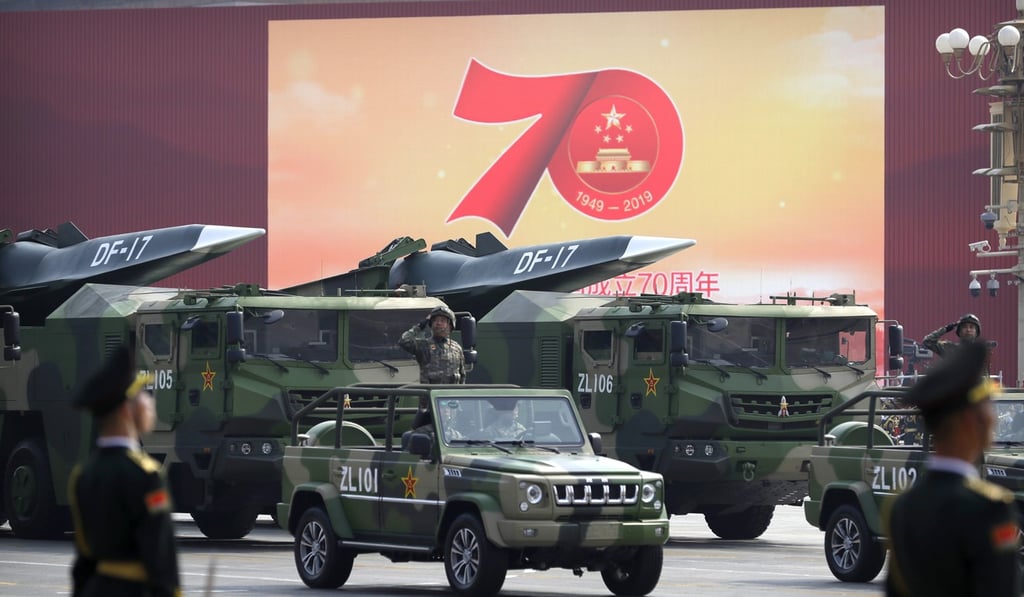
Chinese military vehicles carrying DF-17 ballistic missiles during the parade. Photo: AP
Advertisement
The showing of a powerful military under the Communist Party’s strict control was a message to the country’s tiny community of dissenters and liberal intellectuals that the party will not tolerate any challenge to its monopoly on power. The parade saw the party flag hoisted ahead of the national flag and the army flag – a violation of the law, which says the national flag must be raised first – suggesting the party’s control over the state and the army.
Advertisement
Select Voice
Choose your listening speed
Get through articles 2x faster
1.25x
250 WPM
Slow
Average
Fast
1.25x