Advertisement

AbacusThe national security law could turn Hong Kong into Asia’s Monaco
- The city may soon say goodbye to its port and welcome posh yachts, redomiciled Chinese stocks and even more upmarket property
- Cantonese communities overseas will blossom as they did pre-1997 and BN(O) passport-holder arrivals could be a boon for the British economy
6-MIN READ6-MIN

Hongkongers were recently treated to a dazzling double rainbow over the harbour and a solar eclipse a few days later. In many ancient cultures, both are signs of transformation and indicate a period of flux, but some see solar eclipses as signifying a disturbance of the cosmic order and they have been tied historically to disruptive events. At least the colourful rainbow let us know the air was clean and the sunlight was not diluted by low-hanging smog.
That Hong Kong is in a period of flux was brought home to me recently as I queued for 90 minutes at DHL in Central, surrounded by people clutching large envelopes addressed to the Passport Office in Liverpool, filled with multiple BN(O) passport renewals. A middle-aged gentleman told me he was renewing for the whole family as they were planning to leave. Talk of an exodus from Hong Kong is nothing new, so assessing the actual scale and impact the national security law might have on emigration is difficult. What we can say is that this isn’t the first time.
Advertisement
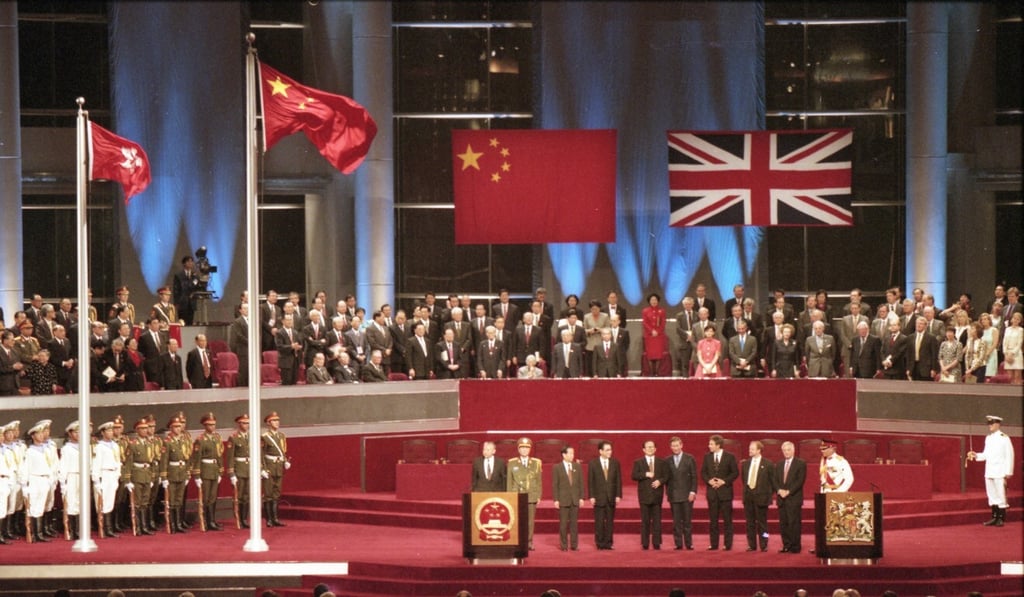
In the years leading up to Britain’s handover of sovereignty to China, Hongkongers shocked by the events in Tiananmen Square in 1989 were increasingly worried about their future. In the subsequent eight years to the 1997 handover, about 500,000 people, or a little over 8 per cent of the population, left for Britain and former Commonwealth countries to secure a stable national identity and a familiar passport. Cantonese-speaking communities in Canada and Australia blossomed as immigrants replicated their lifestyles back home. Back in Hong Kong, it was a struggle to get an authentic local meal as all the chefs had fled.
However, there were plenty of people waiting to move in from the mainland as Hongkongers left, and they have continued to come in at a predetermined rate of 150 per day, with local authorities having no say who comes over – that is 1.26 million so far.
By the early 2000s, with the realisation that the People’s Liberation Army wasn’t pushing people around with cattle prods, many emigrants came back gingerly and Hong Kong went into a sustained period of growth, both economically and in terms of population. Things took a turn for the worse in September 2014 when growing anger and disillusionment among Hongkongers, brewing since the handover over Chinese national education and even the express rail link – what many felt was the mainland encroaching on Hong Kong – manifested itself in anti-government protests that are still going on.
Advertisement
Select Voice
Select Speed
1.00x