-
Advertisement
South China Sea
This Week in AsiaOpinion
Lucio Blanco Pitlo III

Opinion | Will China revisit South China Sea policy as Washington reaches out to Asean?

  • The US has acknowledged the 2016 tribunal ruling as it boosts its efforts to counter China’s attempts to consolidate its hold over the disputed waters
  • While Beijing is likely to dismiss Washington’s latest statement, it must reflect on why the US’ overtures are increasingly getting an audience within Asean

Reading Time:3 minutes
Why you can trust SCMP

02:32

Washington’s hardened position on Beijing’s claims in South China Sea heightens US-China tensions

Washington’s hardened position on Beijing’s claims in South China Sea heightens US-China tensions
US Secretary of State Mike Pompeo’s statement on Washington’s opposition to Beijing’s expansive claims in the South China Sea goes beyond its traditional assertions of navigational and overflight freedoms.
By showing its support for international law, notably a 2016 ruling by an arbitral tribunal convened under the United Nations Convention on the Law of the Sea (UNCLOS), it adds a new dimension in the United States’ efforts to push back against China’s attempts to consolidate its hold over the strategic waterway. Last month, the US also issued a diplomatic note referencing the ruling.

Pompeo’s statement gives full play to a growing range of tools – military, diplomatic and legal – that Washington is putting to bear to oppose what it sees as Chinese attempts to undermine a rules-based maritime order.

Last May, the US signalled its intention to put muscle in its Indo-Pacific strategy by reinvesting in key military capabilities to deter China. Funding for a proposed Pacific Deterrence Initiative will enhance the US defence posture in an area where Beijing has been steadily making inroads in recent years.
Advertisement
However, it remains to be seen how this can be carried out given the constraints and distractions of an election year. As great power competition intensifies in the run-up to a possible leadership change in November, a tougher policy against China is expected.

The South China Sea happens to be just one in a long laundry list of issues where the US and China find themselves on opposite sides. But because rivalry in this critical maritime domain provides the two the opportunity to field in their naval hardware, the risk of a possible mishap is high.
Advertisement
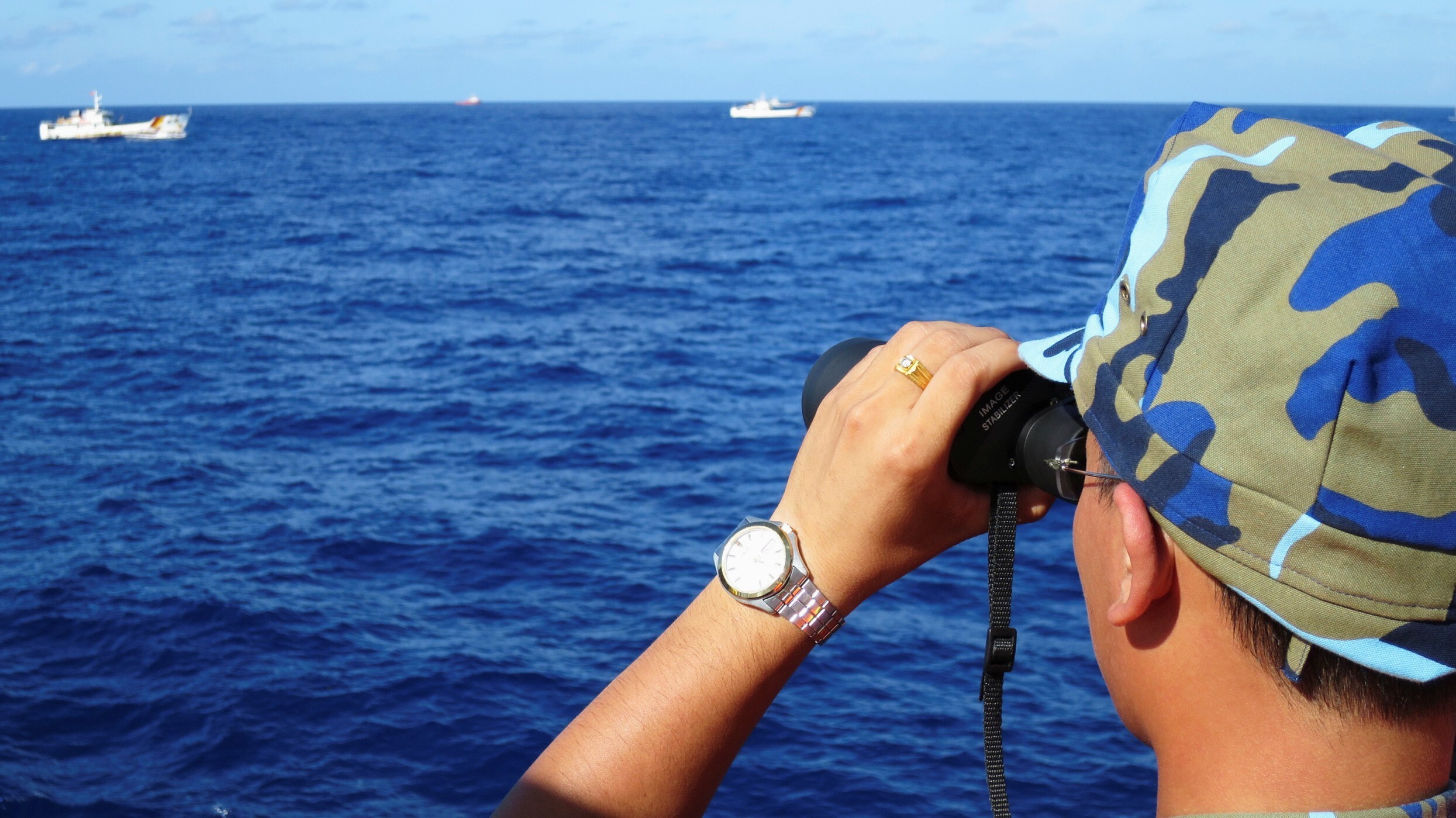
A crewman from the Vietnamese coastguard ship looks out at sea as Chinese vessels tail Vietnamese ships that came close to a Chinese oil rig in the South China Sea on July 15, 2014. File photo: Reuters

The US announcement struck a chord with Southeast Asian nations irked by Beijing’s recent moves in contested waters. Having neither the naval assets nor the ambitions to ply the sea's vastness to fend off China’s attempts at disrupting fishing and offshore hydrocarbon activities carried out within theilarr maritime zones, Southeast Asian countries privately welcome the US naval presence.

Advertisement
Select Voice
Choose your listening speed
Get through articles 2x faster
1.25x
250 WPM
Slow
Average
Fast
1.25x