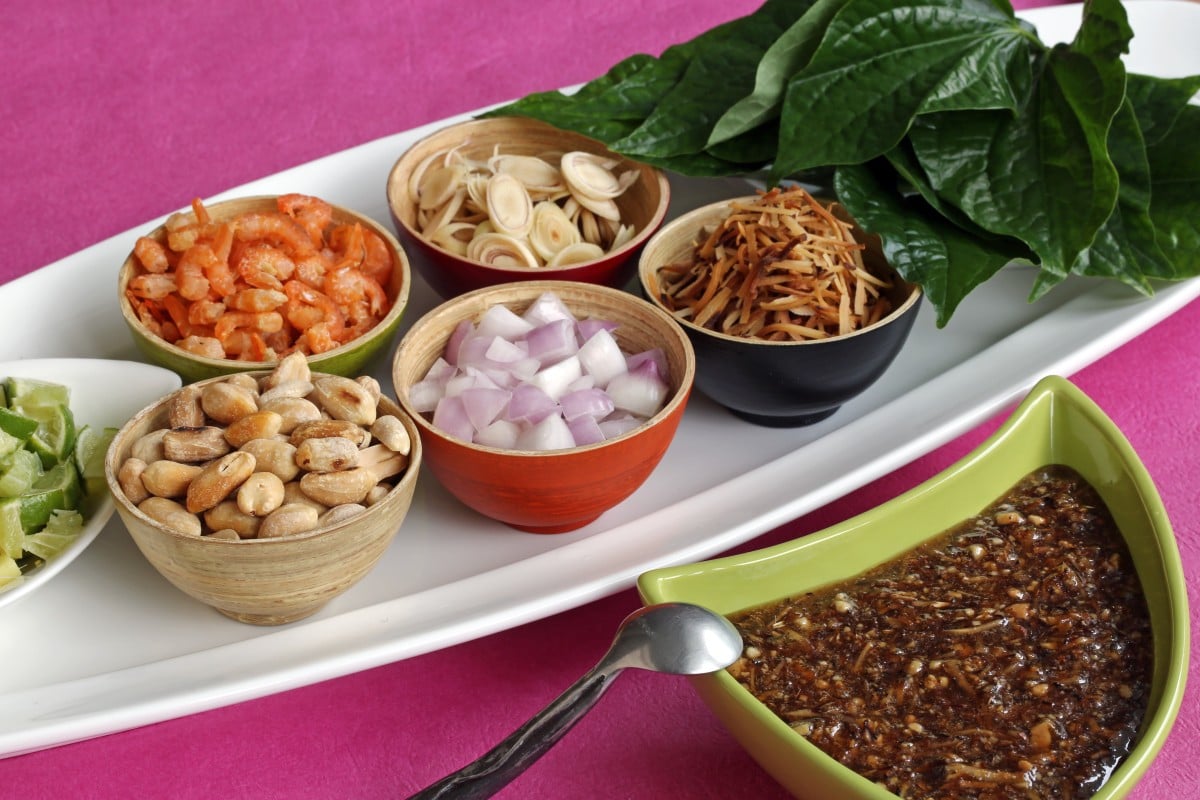
In Thailand, you can get miang kham - wild pepper leaves wrapped around many different ingredients - as a street snack, or as a starter in restaurants. I like to serve them as a pre-dinner snack, with drinks.
This, to me, is a perfect dish. At first glance, it looks like a bunch of ingredients - most of them uncooked - laid out separately. If you taste each ingredient on its own, it seems too strong: raw shallots, raw ginger, bird's-eye chillies and skin-on fresh lime. Those ingredients, plus peanuts and coconut, are essential, but I've tasted versions that add pork cracklings or tiny pieces of salted fish. When you combine the ingredients by putting them in a wild pepper leaf and adding a dollop of sauce, it's hot-sour-salty-sweet, which is everything a good Thai dish should be. It's a hands-on dish, where everyone assembles the mouthfuls as they want them. It takes a little bit of practice to shape the wild pepper leaf into a cone, to hold the ingredients so they don't fall out, but it's not difficult.
The recipe for the sauce makes more than you'll need for this amount of filling ingredients. The leftover sauce keeps well in the fridge; just heat it and dilute as needed.
Thai shrimp paste is not as dry and hard as Malaysian/Singaporean belacan. Buy top-quality dried shrimp that aren't too dry - they should be a little pliable, have a deep pinkish-orange colour and shouldn't smell at all of ammonia.
You'll need to go to Southeast Asian specialist grocers for the wild pepper leaves. At Thai shops, ask for bai cha plu; at Vietnamese ones, ask for la lot leaves. You may need to order them in advance. You can substitute Chinese broccoli leaves or small butter lettuce leaves.
Make the sauce. Finely julienne the galangal and ginger. Thinly slice the lemongrass and shallots. Put the galangal and ginger in a dry (unoiled) skillet and place it over a low-medium flame. Cook, stirring frequently, until the pieces have dried out and darkened slightly. Add the lemongrass and continue to cook, stirring often, until dry and slightly toasted. Stir in the shallots and cook until lightly browned. Put the ingredients in a mortar and add the shrimp paste. Pound to a rough paste then put the mixture into a bowl. Use the mortar to roughly pound the toasted peanuts.
Put the fish sauce into a saucepan and bring to the simmer over a medium flame. Stir in the palm sugar and bring to a boil. Add the galangal/ginger/lemongrass/shallot/shrimp paste mixture and bring to a simmer. Stir in the peanuts and coconut. Bring to the boil, then lower the heat and simmer for about five minutes, stirring often. The mixture will be very thick and sticky.
Prepare the other ingredients. Rinse the dried shrimp in cold water (to rid them of any dust), then dry them thoroughly with paper towels. Cut the ginger, shallots and skin-on lime into 6mm (¼in) pieces. Very thinly slice the lemongrass on the diagonal. Cut the bird's-eye chillies into 3mm (⅛in) pieces. Rinse the wild pepper leaves then dry them.
Lay the pepper leaves (or substitute) on a serving dish and place the shrimp, peanuts, coconut, ginger, shallots, lime, lemongrass and chillies in separate piles or in small individual bowls. Heat about 150g (⅔cup) of the sauce ingredients in a small saucepan over a low flame, and dilute with boiling water until it's thick but pourable. Pour it into a bowl and serve with the ingredients.
To eat, shape a pepper leaf into a cone, add a shrimp and a peanut, some coconut shreds, a piece each of ginger, shallot, lime, lemongrass and chilli, then top with a dollop of the sauce. Eat immediately.