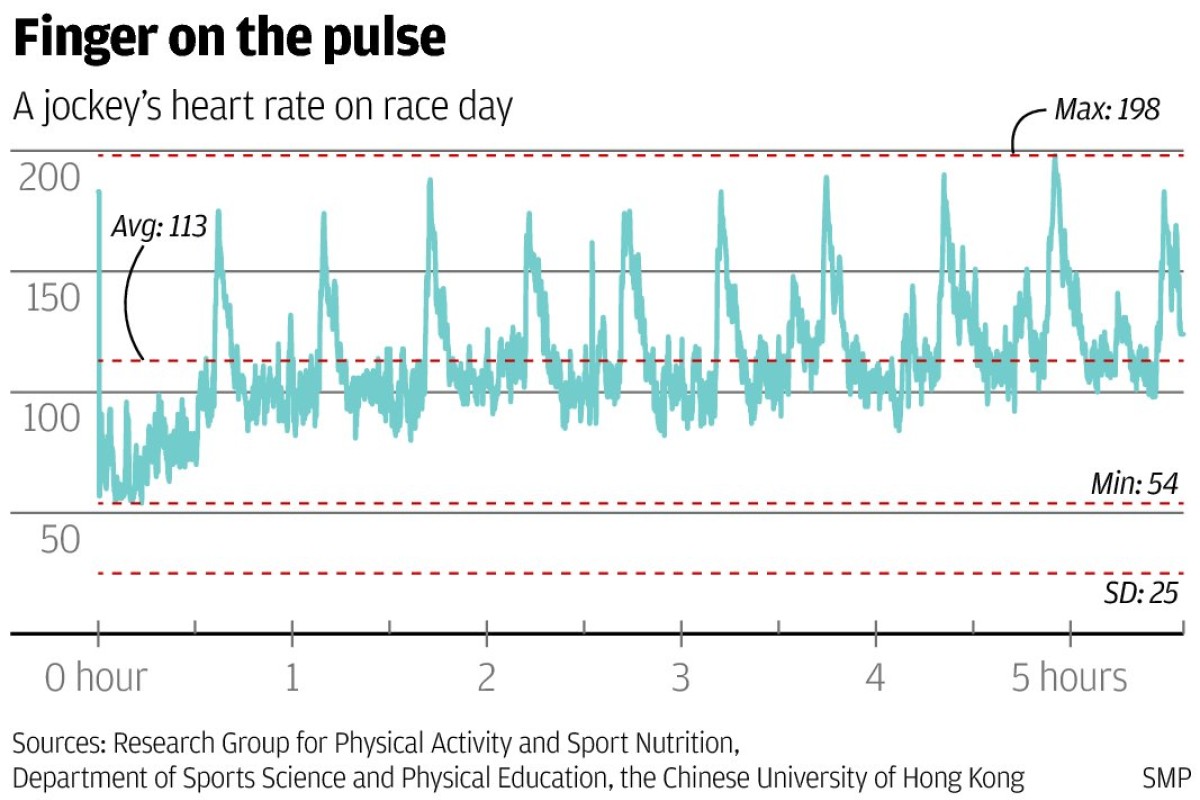
Racing is a game of ups and downs, crash diets and radical weight loss, followed by extreme exercise and all-out adrenaline, spiked with the ecstasy of victory and agony of defeat - all done in what is arguably the most dangerous sporting arena in the world. It's a crazy world graphically illustrated by the data collected from a typical jockey's heart rate during an average raceday.
For the first time ever, a heart-rate monitor was attached to jockeys during a race as part of a Chinese University of Hong Kong study led by sports scientist John O'Reilly. What the data showed was that jockeys' athletic performances are every bit as demanding as other professional sports from an aerobic standpoint - and that's not to mention the ever-present danger of race falls and associated demands on the nervous system. "Nobody had ever seen jockeys' heart rates in a race before and when I saw a few of them, I thought, what is going on here?" O'Reilly said.
The graph depicted here is of a jockey who had 10 rides in one afternoon.
When he arrives on course and is equipped with a monitor before race one, his heart rate is at a relatively relaxed 70 beats per minute (bpm).
But as the build-up to the races begins, his heart rate rises to 90bpm and into triple figures as anticipation builds and adrenaline begins to move through his body. Then the real work begins, peaks of 190-plus bpm, with half-hour intervals in between throughout the day.
Perhaps most interesting is what happens after a jockey rides a winner in race eight. Having attended a presentation ceremony and perhaps still "pumped-up" after winning, his resting heart rate does not fall below 110bpm before the next race - in which he finishes second and sends his heart rate soaring again to the highest point during the day, nearly 200bpm.
"You can see exactly where they are at - massive spike, then back down. It is the same pattern repeated over and over," O'Reilly explains. "This is high-intensity work - and that requires high-intensity recovery. As long as they can get the heart rate back down to normal resting level they are fine. If they go into the next race before their heart rate goes back down, they might not be thinking straight or be too exhausted, and if you are, you might not be thinking too sharply."