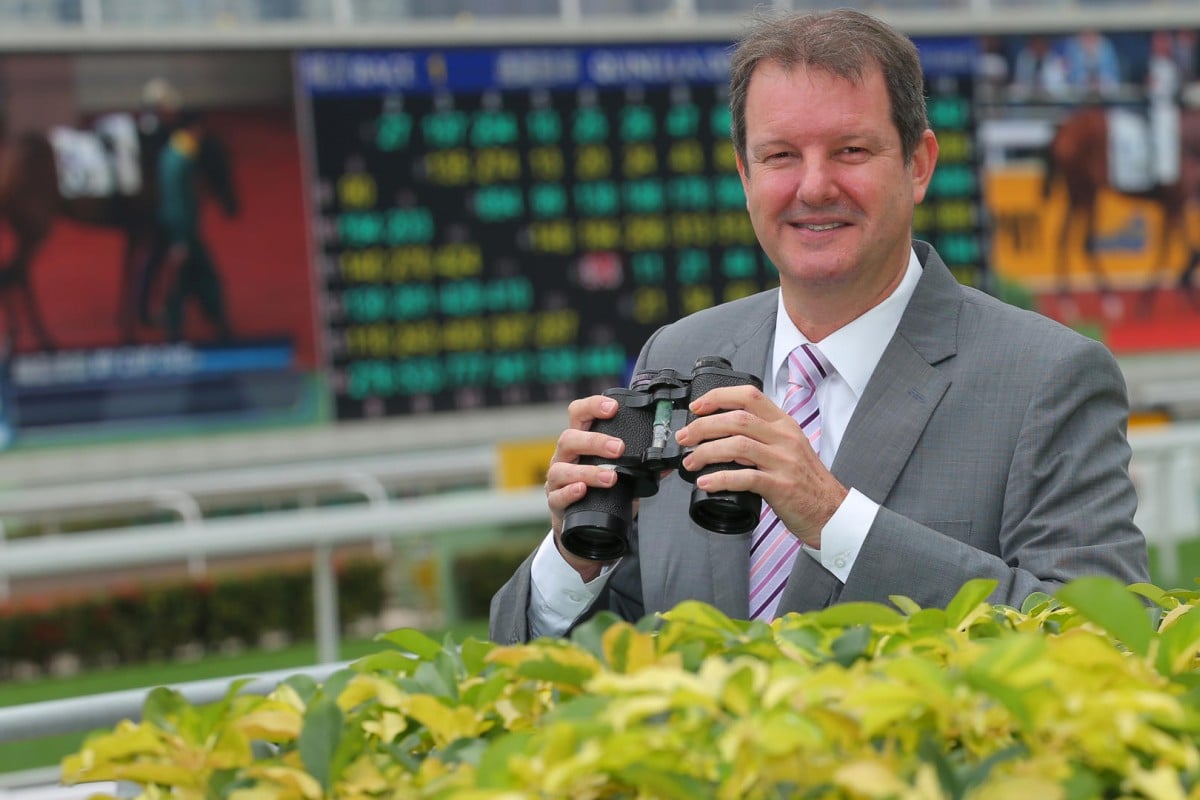
Sydney's best race caller, Mark Shean, knocking back the offer to replace Darren Flindell rings some alarm bells as far as the Jockey Club's aim of getting a "name" caller.
The club has been fortunate in the past with relatively junior callers like Flindell, and David Raphael before him.
Neither was high on the batting order when he left Australia but each blossomed here. It's probably fair to say that another of their predecessors, Richard Hoiles, a top British caller now for some years, also fell into that young, up-and-comer category before his Hong Kong stint.
Hong Kong racing is an ideal vehicle for that - two tracks, relatively few horses or human participants, or races for that matter, which enables the callers to learn the idiosyncrasies of their subject and be ready for them in the run.
Along with the back stories, they are all facets of the action that can be highlighted in calls to colour them up. In somewhere like Australia, a caller has to deal often with many horses previously unseen, as Flindell has been finding out since his return to Sydney.
So Hong Kong has been a great place to polish up the act for young, developing callers.
What's that you say? Why not try that again? Well, that might have been the ideal process had there been no such thing as commingling.
The English language commentary team is the club's window to the world, if you like.
Its worth has long been denigrated by some Jockey Club executives doing the maths on the proportion of money wagered by English speakers.
Even the computer betting syndicates, turning over billions a season and mostly English speakers, weren't considered a reason to spruce things up.
But "here" is no longer the only consideration.
The commingling turnover at the Jockey Club from punters in the US, Australia, New Zealand, Singapore and wherever else it goes in the future is expected to soon be a HK$100 million-a-meeting business.
That's more than US$1 billion a season, and growing. It might not be all the money in the world, in the grand scheme of the Jockey Club, but it's a pretty decent-sized business, and requires a good English-language interface to help it grow.
That's why the club was expressing a certain keenness this time to get a "known" caller. Apparently not keen enough.
The deal with Shean might have swung on something as simple as an accommodation over accommodation. Now the deal with the next "name" could swing on something similar.
Another very well-known Australian caller, from somewhere about as west of Sydney as you can get, is said to be in the picture for at least a chat.
But the view from abroad that Hong Kong Jockey Club equals big money employment is true for only a very few positions in the club. In every other role, it's part salary/part privilege to work here.
We doubt the Jockey Club can afford this new "name" player anyway but the accommodation side of the equation will end all discussions. And we would expect that to be the case with any well-established caller from anywhere.
Apparently the policies and benchmarks of the past eras place low ceilings on the offerings for certain positions and, unless someone with clout reviews those for the English commentary team, then this looks like another opportunity for a young unknown caller somewhere out there, by default.
Send those audition tapes in, people - someone's going to Hollywood!
Moreira hardly alone with potential 'rides of the season'
While we appreciate that John Moore had a vested interest in his declaration of "ride of the season" for Joao Moreira on Bear-Pop on Sunday, we don't think it even won ride of the day. Although the margin was tight.
It was another fabulous ride from the Brazilian and we are often spoilt with the brilliant and frequent performances of so many good jockeys here - it makes for hard work separating our little collection of the five rides of the season in the Post's season review.
But 30 minutes later, Brett Prebble put in a carbon copy of the Bear-Pop ride on Lucky Scepter but without the luxury of a solid tempo. A good tempo helps the openings to come, not only to cross over behind runners from a wide draw in the first half but to find the runs through the field later.
 The seventh race was much more stop-start than the sixth and Prebble had the task of keeping Lucky Scepter, a chronic over-racer, balanced, happy and in rhythm while he got him over to the rail and weaved through.
It was only Prebble's second treble of the season but great stuff from the Australian, who also seems to be forming a strong partnership with trainer Me Tsui Yu-sak, who prepared his opening winner, the two-year-old New Asia Sunrise.
This has not been a long-running game. Before this season, Prebble had won nine of his 99 rides for the yard. This term he has won five of 20, with another seven minor placings, and during May their stats read four wins from 11 runners together.
Tsui has a lot of runners, and usually therefore not the sexiest strike rate, but finished in the top seven trainers at four of the last six completed seasons, including fifth last term, so he does train plenty of winners and it could be a fruitful pairing.
Whilst on jockeys, Nash Rawiller looked somewhat bemused and baffled, like most of us, when Strathmore was home and hosed and still found a way to get beaten on Sunday. The colt appeared to decide it was all over and pulled up, allowing his pursuers to get to him again.
Rawiller just shook his head, though, when reminded that Strathmore is the son of Our Egyptian Raine. She was a Group One winner in New Zealand but much more famous later when campaigning in Australia for her seven close Group One seconds - seven!
Her jockey in most of those? Nash Rawiller.